
Jefferson on attitude, and roundup

Thought for the week:

Nothing can stop the man with the right mental attitude from achieving his goal; nothing on earth can help the man with the wrong mental attitude.
- Thomas Jefferson

I had more exposition written here, originally, but I decided it was long enough to break out into a post of its own, so it will appear tomorrow as a standalone post. Until then, read the links:

6 Tips to Eat Less and Lose Weight: Volumetrics is the idea that you should simply eat larger volumes of less caloric food. That, combined with drinking a lot of water, would seem to be a pretty solid basis of a diet that ‘tricks’ you into feeling fuller. I just wonder if you can construct a varied diet using that trick. I think drinking seltzer also helps, personally – the gas in it is, of course, non-caloric, and having a lot of fizzy water in your stomach does make you feel quite full.

Finances of the Average American: I always find these kinds of stats staggering: 25% of Americans have NO savings. It’s either an indictment of our debt-ridden, consumerist society, or it’s a sad commentary on capitalism.

A Grocery-Shopping Hiatus: How Long Can You Eat from the Pantry?: I’ve often threatened to do this – not buy any new food until what we have is completely gone – but I’ve only ever done it once, when I was single. It’s too hard to get a whole family on board with this idea.

Do You Have to Pay Taxes on Unemployment?: It seems ridiculous to me that you pay into the unemployment system then get taxed on it when you are unemployed and start drawing “your” money back out, basically, but there it is. Good thing we tax that.

Tax Deadlines Spring 2011 and Tax Software Discounts: Hard to believe that tax time is creeping up on us. I wish my broker would hustle to get my forms to me so I could get started.

Are Credit Card Rewards Taxable?: This thought had honestly never occurred to me, but I suppose those rewards do represent income. It just never crossed my mind that I might need to pay taxes on them – read the article to find the answer to that question.

Simple Thank You Gifts For A Host: That’s not a bad idea.

Market Value Measures: P/E, PEG, Dividend Yield, Price to Book Ratio: Always useful to understand the basics.

A Collection of Free Kindle Resources: If you have a KindleKindle, this article can sum up the free resources – there are few alternatives, and rightly so. As Trent points out, writing a book is hard work and authors do want to be compensated. Crazy, right?

A Layoff Story: The Ant, the Grasshopper, the Honeybee & COBRA: I have a “magic number” for an emergency fund that lets me sleep well at night: $40,000. It’s fairly close to Len’s number.

Create Time to Change Your Life: You know, Leo’s blog was one of my inspirations for starting to blog myself. Then I got a little bit tired of the direction he headed with a lot of (what I perceived to be) breezy, non-helpful articles about “just look at the clouds and smile” types of subjects. But recently his blog has taken off again (for me, at least). I think removing comments helped. But I really liked this post, and his book Focus, while repetitive at times, had some very inspirational ideas in it.

Zen and the Art of Investment Banking: When Working Right is More Important than Finding the Right Work: A very good (and long) read. It is true that many of the people who ‘do what they love’ may be exceptions, rather than the rule. It may not be what you do for a living, it may just be your personality which makes it difficult for you to enjoy any type of work.

The Marshmallow Test for Retirement: I’ve heard of this study before, but if it’s true both I – and my family – are in trouble. I can’t even vaguely imagine either of my kids sitting and waiting to eat a marshmallow. Probably something I should work on correcting, except that Bubelah and I are probably the same, at the core.


when things go right…

just drive
If you’ve read this blog for any amount of time you know I’m a believer in positive thinking a la The Secret. I’m not a “wish for a diamond-studded Porsche and The Universe will make it come to you” kind of guy, but I do believe that your mental state and focus on goals do cause things to happen (indirectly, sometimes). It may be that having a positive mental state and well-thought out goals simply means you’re more aware of opportunities as they flash by, or it may be that the Force is with us, always. I dunno - I’m not successful enough to give lectures on the amazing success you can achieve simply through a positive mindset or a white-hot intensity in your pursuit of your goals. Nor am I positive enough or intense enough.

Positive thinking is easier when things are going well, but also when you allow yourself to be distracted by external events from focusing on the negative. I have been busy enough with traveling (a quick family business trip), packing for our imminent move to Florida and some weekend family visits for Pumpkin’s first birthday that I haven’t had much time to read and ruminate on:

  • swine flu
  • the Chrysler bankruptcy
  • the awful state of the US economy, which simply seems to get worse and worse
  • torture memos and so on
  • the Taliban offensive in Pakistan
  • etc.

I’m aware of all of these things, but I haven’t been concentrating on them. Instead, I’ve been focused on getting boxes and organizing books, CDs; canceling and transferring services; and dealing with two stir-crazy kids kept inside for weeks by cold weather and rain (with one brief four-day respite). I’ve found that the very basic focus-on-one-or-two-(or-three)-things-per-day system I mentioned works well, after a bumpy start.

The COBRA reduction came through. Because it was retroactive, I don’t owe anything for health insurance for the rest of the summer, and after that it’s only $400 a month. That makes a huge difference in an unemployed person’s life. My search for work will shift - I can afford to look for the contracting work I prefer without a desperate need for benefits, for a while. I still think the original thoughts I had on the reduction hold true, and several of the comments are also (very) worthwhile reading. I know it’s a lot of money, but think what an effect that might have on the economy if reasonable “bridge” insurance was available to everyone who lost a job.

Other little things have gone right here and there - I fixed what seemed to be a major car problem myself, a refund for several hundred dollars we had been chasing for a while finally came through, and (at least for a few days) we had a taste of summer and what awaits us in Florida. The name of this blog is brip blap for a reason. I bounce back and forth a lot. But when things go right, focusing on the future becomes easier. The trick is to make it a habit, and again and again - for myself - I notice three things make a big difference:

  1. Working towards a definite goal (in this case, moving) and ignoring distractions,
  2. Being outdoors (in this case, we had a few hot days and we finally spent some sun-drenched time outside), and
  3. Staying connected with people (relevant now because of first visiting and then being visited by family and friends).

Moving to Florida will fix #2. #1 - for the time being - is a result of being focused on the gargantuan task of moving itself; once we relocate and get settled, it will be easy to slip back into frenetic activity without a specific goal. #3 will of course suffer for the most part. We’ll move much further away from our families and friends, but I know - having lived in Russia for years while everyone I knew remained in the States - family connections can be maintained and even strengthened sometimes. Relationships with friends can become weaker, but new places often mean new friends, too.

What I take away from positive moments is that our moods are more sensitive to minor triggers than we’d like to admit. I’m not a naturally outdoorsy person but I do much, much better when I get some sun. I’m not a focused person - my attention tends to wander from subject to subject - but when I have big projects I narrow my scope. And it’s easy to get out of the habit of making and keeping friends when you’ve been stuck in a rut or when you’re constantly occupied by small children - a change of pace might be for the best sometimes.

So when things go right, they go right. Learning how to keep throwing another few sticks of kindling on the fire once it’s started burning is the trick to achieving success - and more importantly, happiness.

photo credit: mugley

i saw what you spent last summer


Rich people talk about ideas. Poor people talk about other people.
I doubt it would come as a surprise to anyone that successful people - and by successful I mean happy, or rich, or respected - concentrate on ideas and the future. Unsuccessful people - poor, unhappy, dissed - concentrate on what others have or don’t have.

I fall far more often than I’d care to admit into the “poor people talk about people” category, but I’m going to do it now. It’s easy, now that times are bad. Wondering how this family manages or that family doesn’t is an easy pastime, and it serves a purpose - in examining others’ failures and successes I’d like to get an idea of how I can achieve those successes and avoid those failures. People who looked like they were living the high life are reduced to desperation - after a layoff they seize the first available job with a massive paycut. Others who seemed to be struggling are calm, patiently waiting for the right opportunity.

During The Crisis (we can all-caps it now, right?) the distinction between the narrowly rich and the stable middle class is on display in stark black-and-white - with few shades of gray. I know much better today which of my neighbors are TRULY rich and which of them were just spending themselves into appearing rich. The lifting of the curtain surprised me. An old saying says that you can’t judge a book by its cover, and you can’t. I’m sure that many of our neighbors thought we were struggling before The Crisis. My old Pontiac sat in the driveway in the midst of Mercedes and SUVs. We have a punky little 21″ TV we bought with American Express Membership Rewards points.

But now I am nervous, but confident that everything will turn out alright, while neighbors seem to be panicking. I don’t think I’m gloating, although I’m human and probably am, a bit. I am no poster boy for frugality, for sure, but I make (well, made) six figures, didn’t buy things I didn’t need, and did my best to manage my money. I don’t have the latest phone. I took public transportation instead of driving and paying tolls and parking. I didn’t go into debt for anything other than my home.

I still lost work due to The Crisis, just like all of my neighbors. We will all suffer as the money dwindles - some sooner, some later, but we’ll all have things we’d like to buy that we can’t. It sucks, because we were all middle managers in the Wall Street world - finance managers, audit managers, salesmen, IT guys. None of us deserved to be beaten down because of the idiocy of our executives, but so be it - we lived and died by the sword. And in tough times, your financial weaknesses - which could be kept hidden in good times - are laid bare for the world to see.

photo credit: kimberlyfaye

who is the hero of your life?

Free Me
While watching the movie Hero I realized that I had a belief that might - or might not - be shared by everyone else. It may sound bizarre. If you imagine your life as a movie (or maybe a miniseries, we are talking about a long film), who is the hero of your movie? You, or someone else?
Your natural tendency is to view yourself as the central figure in your story, your life. The only exception might be through a loved one - a spouse, partner, child, anyone significant to you. But even though I might think of my children as being central to my life now, I don’t view them as the “heroes” of my life. I still - selfishly or stupidly - view myself as the “hero” of my own life. I am the one who causes things to happen, who causes things to happen to those close to me, and who can affect the outcomes of events in my life.

Imagining yourself as the hero of your own life is fine as long as you are succeeding, and unbearably difficult the moment you are failing. I wouldn’t expect the opposite approach to be appealing, either - imagining someone else as the hero of your life must either put an incredible strain on the other person or make you feel somewhat helpless. Yet I know people like this. I am quite sure the hero of my grandmother’s life, for example, was my grandfather. My grandfather, a dominant personality if ever I’ve seen one, was a strong and central figure in his family. Maybe that’s just typical of couples where one is dominant; I wouldn’t know, since Bubelah and I are certainly not in the least imbalanced; neither of us seems to feel dominant (yet I still do not view anyone except myself as hero of my own life).

So who is the hero of your life? Is it better if it’s you, or someone else? Does it matter? And can it be someone completely unrelated? Christ, for example, might be the hero of many people’s lives. I would guess that the identification of the real hero in your life probably says a lot about who you are and how you act.

photo credit: h.koppdelaney

conflict and personal finance

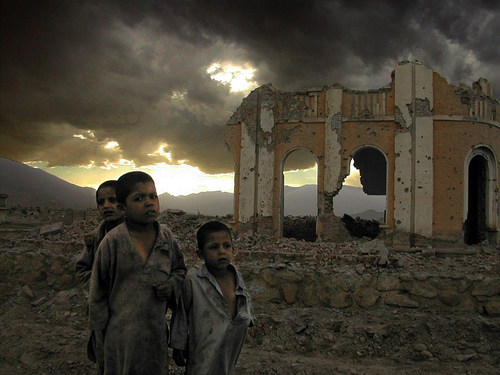
Kabul Kids

I’m sure if you’ve read this blog for a while you know I’m a Russophile. I lived in Russia for a few years in the mid-90s and even once I moved to New York I managed to find a Russian wife. I keep up with Russian news. We eat Russian food, read Russian books to our kids, and I speak in Russian with my in-laws. My son speaks and understands Russian as well as English. Russia and Russian culture are therefore central to my life.

So it should come as no surprise that we have followed the conflict in Georgia closely. That’s not fair … it’s a war, and we’ve followed it as closely as we’ve followed anything in the news. I won’t go into my own (strong) opinion of who’s right and who’s wrong in the conflict. I think there are many things to be said to defend the actions of each side, and the three undeniable truths are that (a) Georgia is learning - to its sorrow - that allying with the US isn’t worth anything when push comes to shove and (b) Russia has regained its superpower status, and the tsar’s grip on the empire is secure and (c) we, ordinary people, suffer when governments play at the game of thrones.

But as I’ve read the accounts, I was struck by something that tears at me again and again when I read the news: how tenuous our hold on our “lives” are. Not our physical lives - but our lives, a complex mix of family, friends, work, health, happiness, possessions, routines and children. None of the refugees in Georgia are worried about how happy their job makes them. None of them are concerned about whether the baby bottles they can obtain contain bisphenol-A. Nobody is complaining because they prefer Dasani to tap water. Nobody is unhappy because they don’t have a BMW like their neighbor. Nobody is thinking about credit card debt. Their lives have moved from the comfortable routine of birth, school, family, work, death to something more like death, death, death. It’s almost impossible to comprehend - I guess - if you haven’t experienced it.

I can’t even begin to imagine what it feels like to have your home and all of your possessions destroyed. I have a 3-month old daughter. We wash our hands before feeding her organic formula with boiled filtered water. We wash pajamas in special baby detergent. I count on high speed internet, my collection of business-casual wear and my hot water for showers. We rely on a certain level of availability of consumer goods and services. I don’t count on a war exploding in New Jersey or New York - at least I haven’t since a few months after September 11th, 2001.

And in the midst of all of this, I do worry about whether what I do is worthwhile, and makes me happy. And I know that many people will say “don’t worry about what’s happening elsewhere - concentrate on what you can control now.” It is good advice. I can worry about my self-esteem while some woman in Georgia (or Rwanda or Iraq or any other conflict-torn nation) worries about how to get clean water for her infant. I don’t know how else to proceed and maintain any sort of sanity. A few years ago I had a female colleague who told us horror stories about her escape from Bosnia in the mid-90s during the ethnic cleansing there. After a while I had to get up and walk away every time she started talking about it. I knew I appeared uncaring or insensitive, but there’s only so much horror that you can voluntarily absorb.

So I try first to remind myself not to watch the news, but I also try to remind myself how - for the present - we in the “western world” are able to live lives that are enviable past comprehension for so much of the world. I know a lot of that dream is eroding, and that’s cause for concern. I know a lot of that dream is a false vision of prosperity - even the most wealthy amongst us will never approach the 5% of Americans who have more than 50% of the wealth in America. But as we watch the Olympics, and the empty tributes to a world united, it’s worth remembering again and again and again that our ability to navel-gaze, like I do constantly, is a gift that only a tiny percentage of the world’s population has ever received.

photo credit: mknobil

The Cambrian Explosion

From Wikipedia:

The Cambrian explosion was the seemingly rapid appearance of most major groups of complex animals around 530 million years ago, as evidenced by the fossil record. This was accompanied by a major diversification of other organisms. Before about 580 million years ago, most organisms were simple, composed of individual cells occasionally organised into colonies. In the following 70 million to 80 million years, the rate of evolution accelerated by an order of magnitude, and the diversity of life began to resemble today’s.

Creative Commons License photo credit: Michael (mx5tx)

A half billion years ago, the only living things on Earth were, generally, pond scum. Life had been around for billions of years in the form of very simple living things, but evolution had ground to a halt. Nothing changed for a long, long, long, long time.

Then suddenly, some sort of event occured that scientists call “The Cambrian Explosion.” In the next 70 million years - an exceptionally short period of time, in terms of the history of the Earth - the number of species exploded. You had little critters, not just algae. You had trees, bushes, insects, all kinds of animals. And we have no idea why the jump occurred from single-celled pond scum to scurrying critters. None. Darwin said this event was the big, big, BIG hole in this theory. Some freak event happened and everything that’s come since originated from that funky timeframe.

Darwin’s theory of evolution by natural selection is taken as fact by most people. I do; to me, even if you believe in God Darwin makes sense. God’s complex enough to design evolution, I think. But even Darwin said the Cambrian Explosion cast some doubt against his theory of evolution. Life had dribbled along for eons without any change, then BOOM! Big change happened in a short period of time. Mutation must have exploded beyond any reasonable or possible level to make the Cambrian explosion occur.

Here’s my question: do most of us have a moment of Cambrian explosion in our lives? In my case, it happened when I read (completely by accident) Rich Dad, Poor Dad. It’s not that I was stupid about money - I had plenty of savings, I was making a lot of money and I was living relatively frugally (albeit with the almost obligatory-excessive Manhattan lifestyle in regards to social life). But I suddenly had a flash of inspiration: the goal was not to maximize my income from my job so I could maximize my spending, the goal was to maximize my LIFE by making my income sufficient to cover my expenses for the forseeable future.

That’s no small achievement, and to this day I would thank Kiyosaki for that insight. But that insight was driven by an external force, and I never would have found it without reading that book. Dumb story: why did I buy Rich Dad, Poor Dad? Because I had a child on the way and I searched on amazon for “finance for dads.” All I wanted was tips on 529s and similar things. I didn’t ever consider that the greatest gift I could provide my son was a mom and a dad who were financially independent and no burden on their kids, even though that’s probably the greatest gifts MY parents have given my brother and me.

Most of us do have a Cambrian explosion in us; a moment when some dumb chance (or divine intervention if you’re so inclined) strikes us and causes a staggering change in state. Make sure you’re open to it, ready for it and willing to accept it - even if things were working before and you don’t see the need for the change.