
why I will not live in the northeast forever

A constant topic of conversation I have with my wife Bubelah is where we want - or should - live. We live in a suburb of New York City (the only major city growing in the northeast). Our cost of living is horrific. We have a three-bedroom townhouse that cost just shy of half a million dollars in 2004, pre-boom. Our house would go for almost $600,000 today. I think this topic goes well with an ongoing debate at The Simple Dollar.

When we bought the house, we received an abatement. For those of you not familiar with New Jersey’s blood, er, property tax, municipal governments often give a break to new construction for a set number of years. The way it works is that our house is taxed at the same rate as any other house in our municipality, but the assessed value is reduced by a set percentage. So a house, having been assessed as being worth $400,000, will be taxed as if it had been assessed as $300,000. This tax treatment will continue for another 4 years.

However, once it ends, our property tax will leap upwards. How much depends on the rate at the time and the new assessment. This situation wouldn’t be so bad if not for the fact that we already pay almost $700 per month in property taxes, plus over $200 in association fees (road upkeep, lawn upkeep, snow shoveling, etc. - not a bad deal, actually).

In five years, therefore, we might be paying approximately $1200 per month in taxes and fees. This is before our mortgage of almost $2000 per month. This means that simply to keep the house my after-tax income must be $3200 just to pay for the house. Before paying the utilities, for food, for diapers, for anything else - $3200 after tax or the first $50,000 of my gross income per year goes to housing costs. If we ever paid off the mortgage, we’d still have $1200+ per month to pay for all eternity.

All of this might not be so bad if it wasn’t for the fact that the property tax goes to service municipal debt, a failing school system, broken roads and awful municipal services. We have only two municipal parks in a city of a half million, potholes litter the roads, and large areas of the city aren’t safe after dark. We have concluded that the public schools are not an option for Little Buddy.

My point is that we must really, really, really love living near New York to put up with all of that, right? There are other considerations - Bubelah’s extended family all live in New York, my parents are nearby, and we desperately hope for a continued gentrification of our city (and it is happening in fits and starts). But are we crazy?
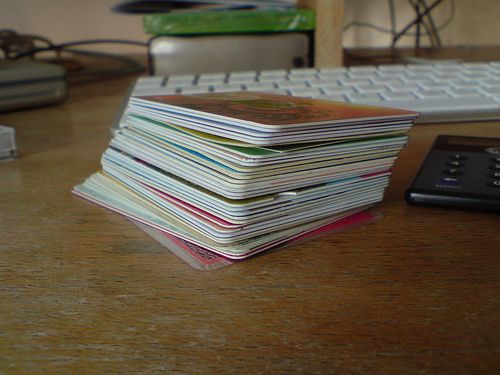
Consolidating accounts

stack of credit cards
Creative Commons License photo credit: kalleboo

One of the best financial moves I made had very little actual net worth impact, but significantly improved my quality of life. After Bubelah and I got married, we did a quick inventory of our bank accounts, credit cards and brokerage accounts. I don’t remember the exact numbers, but between us we had at least four bank accounts, 20+ credit cards and approximately 12 brokerage accounts (and I’m including company 401(k) plans, IRAs and so forth). I had three direct-investment stock plans where the stock was held by the company, too.

We decided to consolidate to two banks, two brokerages and effectively to four credit cards. Why? Here are our reasons:

Banking

We chose our bank for our business and personal checking for two reasons: they have a large number of physical locations in the New York City metropolitan area and their account fees were reasonable (basically free checking). I could not think of any particular reasons to go with another bank, simply because we saw their branches everywhere, and in particular several convenient to our home. The fees were fine, because as long as we maintain some reasonable minimums (approximately $500 per account) we don’t pay anything. We don’t receive interest but we try to keep a bare minimum in these accounts.

We chose an online bank for our emergency fund and other savings. We could just as easily have used ING or Citibank, but at the time we decided to open an account HSBC was offering the best rates. As we have extra money in the checking account we transfer it into our online savings account. HSBC (similar to other online high yield banks) has a structure friendly to people with frugal natures. The account pays a very respectable interest rate, and it takes some small effort to withdraw funds, meaning spur-of-the-moment withdrawals are unlikely. We understand that the money in this account is not returning what our stock accounts are, but this is the conservative, worst-case scenario money so we don’t mind have a stable rate of return in exchange for very low risk. You can learn more about HSBC’s savings account here. I highly recommend it.

Brokerages

We went with two separate brokerages for our accounts. We ended up going with two brokerages for several reasons:

  1. I started moving my brokerage and IRAs before Bubelah did. I started this process because I was unhappy with my brick-and-mortar brokerage’s high commissions and awful online experience. The broker I chose, Ameritrade (now TDAmeritrade) had much lower commissions ($7.95/trade) and a much more pleasant online interaction. I am not a day trader anymore, so the commissions were not a critical factor, but I don’t rely on a broker to make trades for me and so I felt little need for expensive ‘actual person’ trading. Bubelah chose another low-cost online broker with similar commissions.
  2. We had to keep separate IRAs so we thought it would be simpler to keep one brokerage account and several IRAs linked without a lot of confusion over which account belonged to whom.

Both of us had a vague fear of putting all our investment assets in one basket. While I have no reason whatsoever to worry about either of these firms, we didn’t want to be in a position where everything we hoped to use for retirement was held by one (virtual) company.

Credit cards

Our consolidation of cards was a mixed success. The easy part was the store cards. We canceled all of them. We kept one card as our ‘main’ card. We had to keep a debit card associated with our bank account, and I had a flexible spending account card through my work. Other than that, we kept three more credit cards, for different reasons.

  1. A card for business purposes. Bubelah runs an online business so we decided we should keep any purchases necessary for the business on a separate card. We have a separate checking account at our bank, too.
  2. A ‘legacy’ card for Bubelah, because of the points. She had been using the same card for years and had accumulated a large number of points/miles on the card, and wasn’t willing to lose them all. Plus, it was in her name alone and we decided it made sense for us each to have our “own” card which would not be a joint account.
  3. One card in my name only, for the same reason - I wanted something in my name only, because other than this card every single thing we own is joint.

The biggest benefit to the whole process is saving time and increasing awareness of spending. When you get one huge bill each month and know you have to pay it off in full, it makes you think twice before spending. We always pay the entire balance each month, so it’s almost like spending cash. However, you get spreadsheet downloads showing when/where/what you bought, and you get points which we have used to save thousands on hotels, flights and so on. We have put almost all of our spending on the card, including automatic charges (cell phones, utilities, etc.). I think it helps to see all of your spending in one place, and it greatly simplifies bill-paying at the end of the month. We only write 1 physical check each month. All of our other spending is through automatic bill payment on our bank or through our main card. Even the mortgage is automatically withdrawn.

If you haven’t already considered consolidating your accounts, consider this: it will take a tremendous amount of time to track down all of your information, move your accounts (particularly investment accounts) and close unneeded ones, but the time savings on the other end of this process are tremendous. Where once we spent hours flipping through paper bills for our dozen credit cards and trying to figure out which account to pay it out of, we now just automatically pay our one credit card and get two statements for our investments. We have a clearer picture of our spending by seeing it summarized in one credit card per month. I believe anyone could benefit from making their finances simpler and reducing the time spent on them.

Landlines

I wonder how long it will be before I can get rid of my landline. It’s a source of constant irritation to me. It costs almost $60 per month for the cheapest flat rate program Verizon has. It includes unlimited long distance and local calling.telephone

This seemed like a good idea when we moved from New York to New Jersey. Since Bubelah’s family lives in New York and mine in Virginia, we made a fair number of long distance calls. However, with all of our families on Cingular, oops, AT&T, we get mobile-to-mobile minutes free.

So why don’t you get rid of the land line and just use the mobile phones?” you may ask. Good question. First and foremost, the sound quality on the Samsung phones we have is really poor. They are little flip phones and you have to bellow to be heard. If we had better phones we might not have such terrible sounding connections. Then again, that may be wishful thinking and it may just be the service.

Second, we have a family plan with limited minutes. I use my cell occasionally for business, and we have five people on our plan using 500 minutes per month. I imagine we don’t use our landline that much during the day, but it still might strain our minutes.

Third, I remain distrustful of internet phone services. I really have to see one someday, but no-one I know uses this yet. If I saw it and used it and it worked I might be able to get it myself, but I’m afraid it will sound like Skype, the equivalent of using a walkie-talkie for a conversation.

Finally, and in some ways the most important but easiest to overcome problem, I remain worried about 911 calls. Landline 911 calls go right to, well, 911. I have the police emergency number programmed in my cell phone, but I have never ‘tested’ it and I remain concerned that in an emergency a mobile won’t be enough. I remember very well from my childhood and from 9/11 times when everything went out, but the phones stayed on. Electricity out because of snow/lightning/blackouts? The phone still works. All mobile phones dead because of swamped communications during 9/11? Landline still worked, and I lived in lower Manhattan, the heart of the storm.

I guess in this instance I’m just not thinking clearly. We plan to upgrade phones soon, primarily to get features that we need with a toddler around. “What does having a toddler have to do with your type of phone?” Well, try carrying a toddler around while talking on your flip phone. Try talking on your flip phone around a toddler who loves phones and yells if you don’t give it to him. We really want Bluetooth phones, or at least speakerphones, so we can go hands free easily in the car or while pushing his stroller or even while chasing him around the house.

So hopefully a new phone will have a better connection and interface and we’ll be able to finally kill off the landline and save that ridiculous $60 per month. I really wonder what the future is for landlines, because I don’t see what they can do faced with this.

Health, wealth and social responsibility

I fight a mental battle over health, wealth and social responsibility all the time. Let me give a brief example. For my son’s room, we bought some blinds. These blinds were behind the curtain, and just there to block out the early morning sun so he could sleep a bit. After a while we realized they weren’t doing a good job. They were white, and thin, and didn’t block the bright blast of the early morning sunrise.

So we went and bought a second set of blackout shades. I took down the blinds and replaced them, and the room is much brighter. Here’s where the battle begins.

Health: I really want to de-clutter the house. I have no other windows where blinds would be particularly useful. Result: Throw out the blinds.

Wealth: I may need the blinds someday in the future. This exact situation has happened before - I threw out something and then needed it two months later and had to buy a new one. Result: Store the blinds somewhere in our cluttered storage room.

Social Responsibility: I may need the blinds in the future, but I doubt it. Maybe someone else needs them - maybe a neighbor, a family member. Throwing them away just adds to a huge trash mountain somewhere on the eastern seacoast, a thought that makes me sick. Result: Try to give the blinds away, probably with limited success (they are not heirloom blinds, after all) and they sit in the storage room.

Before I go any further, I know the answer is that I shouldn’t have bought them without thinking more about it in the first place. But it really fulfilled a particular need, they fit the window perfectly and my honest, reasoned thought was that all we needed was a light diffuser, not a blocker. I didn’t count on Little Buddy being such a light sleeper.

This mental battle is played out again and again. I know throwing out clutter adds to garbage. I have 10 old black binders I have not used in 5 years. I have no need for them. Yet I keep them, because I hate thinking of them sitting in a trash heap somewhere. However, the clutter they create is really annoying. Clutter ruins mental (and even impacts physical) health in my opinion. Yet throwing out the clutter may be wasteful, and it’s certainly not socially responsible.

So given a situation like this, what to do?

I try to take this approach these days: if I cannot instantly come up with a use for it, I have to throw it away. I kick myself about it, but throwing it away now or 10 years from now has the same end result for the environment, but very different results for me personally. And when I throw away big items I will think long and hard before buying my next big purchase. However, I think the battle will go on and on as long as I continue to buy new things. The secret is not to buy ANYTHING new, ever, but that’s hard to do. It’s a habit we work on, but it really involves undoing the habits of a lifetime… which is what personal improvement is all about, after all.

in defense of Netflix

I have a subscription to Netflix. I realize this is not frugal. I realize I shouldn’t be watching TV. I do, however, have five points I can make in defense of Netflix.

  1. We don’t have any premium channels other than some Russian language channels. Bubelah really enjoys being able to watch TV in her native language, and I don’t really have a problem with it since otherwise she would hardly ever hear it other than from her family. We canceled all of our other premium channels after we got Netflix.
  2. It controls the quality of our movie viewing. I really liked Rush Hour II. I usually was pretty happy to see it come on TBS, or The Matrix. I thought watching it for the second or third time was no problem. However, when I saw Rush Hour II for the eighth time and watched Sweet Home Alabama for the second time - yes, you heard that right, I am not proud of it - I realized I was really wasting my time. Watching a movie twice is OK. A great movie like The Fountain, Snatch, or The Irony of Fate may be worth watching once a year. But no-one needs to see Blue Streak more than once. With Netflix, I generally ensure that I only watch movies once, although I may use it to see a classic that I haven’t seen in a long time. Right now on my queue I only have two such movies - Wall Street and Dr. Zhivago.
  3. We watch and return movies rapidly. With rare exceptions, we watch a single movie over two nights. After Little Buddy is asleep, the house is cleaned and we’re ready to relax, we’ll usually watch an hour of a movie before turning it off an hour before going to sleep. So we keep one movie two days, return it the next day, receive a new movie the next day. So if I receive a movie Monday, we generally have the next one in our hands Thursday night. Since we have two subscriptions, that means approximately 2-3 movies per week, or approximately 4-7 hours over a seven day period.
  4. I no longer watch any TV other than Netflix. I decided over a month ago to stop watching all TV. I don’t turn our satellite on, ever. Bubelah may watch a program in the evening, and I may watch it too, but for the most part I don’t watch anything except Netflix. If I didn’t have the new movies coming in for entertainment, I might break down and watch The Matrix for the 13th time, and yes, it’s that good.
  5. Netflix broadens your horizons. I have already seen a dozen movies on Netflix that never would have been shown on any channel on American TV. We’ve rented Israeli, Swedish, Russian, Italian and even obscure American films that we never would have seen otherwise. Many of them are good, and some have been uplifting. Some have been horrible, but that’s to be expected. Some have been deeply moving, and I am glad that I saw them.

I know Netflix is not a frugal choice or maybe the best use of time, but I like it and intend to keep it for the time being.

Reading in early childhood

Little Buddy doesn’t watch much TV other than an occasional DVD to keep him distracted when he gets too anxious, but I think we have already managed to make him love books more than TV. I have no illusions that this will always be the case, but right now if you turn on the TV and wave a book at him, he will grab for the book every time. This was a fairly simple process, and there are a few simple ways you could do this, too.

  1. Buy books before the baby is born. You simply won’t have the time or patience the first few months to look. Get a few classics before the baby arrives - Good Night Moon was the first book we got for Little Buddy (other than hand-me-downs from my childhood).
  2. Start reading to the baby in the womb. This is not for any reason other than to get used to doing it. I had almost zero experience reading children’s books. Once in a blue moon I read to a child, but it could not have been more than a dozen times in my whole life. But reading to your wife’s stomach a few times helps relax you and gets you used to the idea of it. There is no need to do this a lot, just a few times until you are comfortable with it. I wish I had done it a bit more than I did, but the few times I did were enough.
  3. Read to the baby when he is born. I read Little Buddy books as soon as he came home from the hospital. I read him books in his swing, then on a mat on the floor, then holding him in my lap as soon as he could sit up. People thought I was wasting my time, but he started focusing on the book as a source of happiness very, very early on, and as soon as he could crawl he would crawl to the books and bring it to Bubelah or to me.
  4. Buy a limited number of books. Only buy a dozen or so books, and learn them well. I can recite most of our “greatest hits” from memory. I have a set of standard sound effects to go with them. I think if I read a new book every night it would be difficult to have the same consistency, and very young kids love consistency. We read “The Little Bunny” hundreds of times, always in the same tone of voice, always with the same “effects” - and he still remembers all of them even now that we don’t read the book as much anymore.
  5. Read to him in more than one language if possible. I am fortunate that my wife is not a native English speaker, so we can have two sets of books. I am further fortunate that I speak her native language, Russian, and that she speaks English fluently. We try to stick to our native languages while reading, to ensure Little Buddy learns the correct pronounciation and accent, but we switch back and forth and in a sense I think that keeps him entertained, too. If you speak a foreign language and can read it - even slowly - try buying a few books in that language, you will be amazed how well children can pick up two sets of words. Little Buddy already clearly understands both languages.
  6. Make reading interactive. Don’t go for more than a page or two without asking a question or deviating from the text. Just as with adults, repetition can lead to inattention. Although I know I said babies love consistency above, they don’t love dull repetition.
  7. Above all, make reading fun. I seldom read any book with Little Buddy without a constant stream of sound effects, tickles, faces and even some running around or lifting him up in the air. Different books have different purposes. Hand Hand Fingers Thumb is exciting. The Runaway Bunny is calming. Both are fun - they just have different cadences, tones and actions associated with them. One of the worst things to do is make reading dry and dull. An infant or toddler probably won’t understand the great majority of the words in a story, but I always show Little Buddy my arms outstretched pretending to exercise when we see that word in one of his books. Now, when he hears that word, he stretches, too. The same goes for grasshoppers, monkeys, balloons, fire trucks and so on.

All of this has paid off handsomely for us. Although we didn’t follow all of these tips all the time, it is a great feeling as a parent to watch your child walk right past a turned-on TV to grab a book and either read it himself or toddle over to you and put it in your hands, then plop down on the carpet and wait expectantly for you to read it.

true rates

I get paid on an hourly rate, and one of the things I do obsessively these days is try to figure out what sort of hourly rate I would need to generate as a freelancer. There are a million imponderables, of course - different rates for different tasks, different rates for different clients, include expenses or not, and so on. But one of the interesting exercises I did was try to figure out what I actually make today on an hourly basis including all of my daily expenses. I learned a couple of things from this calculation.

So for the sake of this example, here are a few of the variables:
Hours 8
Commuting hours 2.5
Rate 50
Tax rate 25%
Lunch 8.00
Coffee, extras 4.00
Parking 8.00
Public transport 5.25
Gas, wear and tear 1.50
Dry clean shirts 0.75

A few of these costs are more or less fixed. The tax rate is a rough estimate. My federal and state rates are higher, but get reduced due to mortgage interest deductions, etc. I usually figure 25% is a fair approximation of what finally goes out.

My parking and public transportation costs are hard to alter. The public transportation is reduced slightly by using an FSA pre-tax benefit card, so that’s $5.25 rather than the post-tax $7.00 per day. The parking is the best rate I can find near my station. I could take a light rail near my house that would cost $6 per day instead of $8, but would increase my commuting hours by another hour per day at a minimum.

Gas and wear and tear on my car is a very rough estimate. I fill up less than once per month, since we don’t use my car for family driving. So for the sake of argument it costs me $50 per 60 days to operate the car, plus a little for wear and tear on the tires, oil, etc. The federal mileage allowance is $.485 per mile (http://hr.blr.com/human_resources/mileage_allowance.htm), and I drive about 4 miles round trip per day, or $1.94. So split the difference, $1.50.

Dry cleaning my shirts costs $.75 per day. I’ve tried to shy away from the fancier shirts and pants I used to prefer that required dry cleaning, rather than just launder-and-press. $.75 is a lot per day, but I think the amount of time spent on ironing isn’t worth it. The shirts won’t look as good and it just takes me too long to do it.

The killer in this calculation was the lunch and extras. I like a salad for lunch most days, and of course the salad bar is a quick and easy option. I get a by-the-pound salad, so a cucumber slice costs a lot more than a piece of lettuce. I started tracking my costs and was surprised that I average $8 per day on salad. This is part of the battle between health and wealth. I need to cut it down, though.

The extras are the worst item. I sometimes want water on the subway. It gets hot and the air is tepid, and a cold bottle of spring water really helps. That costs $1 if I forget to pick up a case from the supermarket. My client doesn’t have coffee machines, so that’s another $1.50 for cafeteria coffee. And inevitably during the day I may want a seltzericon, or an apple. So that may run anywhere from $0 to $4 per day. I recently started drinking black tea at work, since a bag of Tazo high-end black tea costs 20 cents per tea bag and has just as much caffeine as coffee. That should save me about $300 per year.

After all of those expenses pile in, my net is much lower. If you include my commute time in the calculation, that’s about $26/hour, or $208 per day. If you don’t include commute time, it’s $34/hour and $272 per day. I include the commute time since that’s working time - I’m not doing it for fun.

What can I take away from this? All of these expenses are directly arising from traveling in to a major metropolitan area to work. I effectively make $26 per hour on a 10-10.5 hour day. So if I worked from home making $30 per hour after tax, 8 hours per day, I’d be better off. In my industry $70 to $100 per hour pre-tax is a fairly common and easy range to achieve for in-office work. I don’t have a good estimate or remote work, because auditing is typically on-site.

This exercise made me realize two things: 1, if I worked from home I could charge a much, much lower rate than I charge for going into the office and still net more. 2, I spend an awful lot on unnecessary items. As a consultant, I often talk myself out of bringing my lunch, since I don’t know where I’ll be, or I won’t know if they have a fridge, or whether this will be the day my client wants to have a lunch meeting. I should learn to overcome that, because $12/day is ridiculous.

Using these numbers, though, my main thought was that 50% of my rate is gone before it hits the bank account, effectively. That is a sobering percentage.

follow the Poor Dad sometimes

If you spend any time on personal finance sites, you’ll hear about Rich Dad, Poor Dad. Personally, I would credit it with a tremendous amount of influence on my life since I read it in late 2003. This book changed the way I think about money, about priorities and even about life in general. I plan to review it in the near future.An important distinction, however, is that not all of this change was good. One of the main tenants of Rich Dad is ‘maximizing cash flow’, or attempting to push expenditures as far into the future as possible. A very common way of maximizing cash flow would be to take a balloon mortgage, for example, where payments are low or interest-only for several years then escalate.

At the height of the housing boom we bought our current house. Fervently embracing the concept of maximizing our cash flow, we attempted to get an interest-only monthly floating rate mortgage, which would (at the time) have resulted in sub-$1000 per month payments on our half-million dollar home. After 5 years, the payments would shoot up, but we were convinced we could easily refinance or move or somehow avoid that situation.

Fortunately for us, the neighborhood we were moving into did not meet the lender’s criteria for “aggressive” mortgages. It was too new, and there was not enough payment history for the neighborhood for them to measure the risk of default. Our mortgage application was rejected, and we proceeded to obtain a 30 year mortgage at 5.6%. This meant our payments were almost double what we had hoped, and we were not happy.

Three and a half years after being turned down for the adjustable rate mortgage, we still have regular payments. With the increase in interest rates we would be paying almost the same amount on the ARM that we are paying on our traditional mortgage, but it would all be interest. The balloon payment would be looming, and our cash flow would be no better than it is now.

So in retrospect we were saved from ourselves. Despite the fact that we think we are fairly savvy people about finance (she has a degree in finance and I have an advanced degree in accounting) we lucked out by being turned down for the ARM. I doubt we would have done much with the ‘maximized cash flow’ since our first thought would probably have been to invest in more real estate, again using ARMs. Doing so would have compounded our error, and now we would be facing a mounting avalanche of debt.

I think the moral I take away from this is that even when you follow a particular philosophy or guru, you should always consider a worst-case scenario. Sure, the traditional mortgage has cut into my income and made it difficult to consider vacations and larger purchases. That pales in comparison to the ARM worst-case scenario: being forced out of the house.

As a postscript, I still think that Rich Dad, Poor Dad is a critical read for anyone who lives in America. Kiyosaki makes excellent points about working for income versus investing, and made clear to me for the first time that what I wanted to be able to buy was time, not things. Financial freedom is the goal, although I had never heard it put so plainly. So please don’t read this as an indictment of his book. I highly recommend it, but as with anything else in this life you have to be cautious and conservative when dealing with your home, your family or your health. Without these three things all of the cash in the world will be useless.

Other reading:

Rich Dad, Poor Dad:  What the Rich Teach Their Kids About Money-That the Poor and Middle Class Do Not!

teaching risk tolerance

Re-establishing an exercise routine

I recently went to the doctor for a full physical for the first time in three years. I waited so long because I always had something “more important” to do: busy with a new job, Bubelah was pregnant, Little Buddy had arrived. If you have a newborn at home, you feel like you’re at the doctor far too much. Between shots and colds and the other hazards of infanthood, a visit to the pediatrician on a weekly basis seems normal. So after visiting the doctor and finding out that nothing was wrong other than a cholesterol level higher than ideal (but still within normal ranges) and the fact that I was overweight, I realized I have to get started exercising regularly again. I’ve been exercising but intermittently, and a bad weightlifting episode a few weeks ago really set me back. These tips are almost ‘live’ for me, since I am applying them right now to try to get back in a routine.

Any exercise is better than none. I have always enjoyed running and lifting weights (although a very specific method to build core strength, not muscle mass) and not much else. Running, when you are doing it well, gives you a ‘high’. I have been trying to motivate myself to do push ups or more ‘muscle building’ weightlifting, and I have a lot of trouble with these exercises. I realized that I need to focus on exercise I enjoy, because even if it’s not as effective for my goals, they will work much better than a planned and skipped targeted exercise.

Take it easy. I made a huge mistake trying to ‘lift to failure’ a few weeks ago. Lifting to failure means that you lift the heaviest possible weights you can, for as long as you can maintain good form. The most common sort of weight training is set training, where you lift a moderate weight eight times, then pause, then repeat for as many sets as you are able (usually expected to be 2-4 sets). When I lifted to failure, I was sore for days and didn’t feel like exercising again for almost a week. Before you write that off as a mistake, understand that my intention was to start building muscle mass, and lifting to failure is a good way to do that. After one session I felt some noticeable improvement in my biceps. But the damage done to my workout program from skipping a week makes it a bad idea.

Set public goals. Setting public goals is an idea proposed by many self-improvement gurus. Leo at Zen Habits is a particular proponent of this idea. Make sure people know you are planning on running the next day. Often a mild embarrassment at missing your run and feeling a need to sheepishly defend your decision to skip is enough to make you pull yourself on out the door.

Get ready beforehand. Little Buddy is a light sleeper, and his nursery is right next to the study where I keep my running gear. If I don’t get the gear out the night before, I have to tiptoe with an insane amount of effort into the study to retrieve my socks and running shorts and shirts without waking him. Fear of waking him early, which means a long cranky day for him and for Bubelah, means that I might skip a workout if I forgot and left my gear in the study. So getting everything out and taking it downstairs to the living room the night before makes a big difference! Eat. I have made the mistake before of launching a diet and an exercise program at the same time. For me, at least, this is a bad idea. Weightlifting in particular requires fairly substantial food intake. I try not to alter my eating patterns and my exercise patterns at the same time.

Enjoy. Too often people view exercise as a chore, but every time I work out I feel better afterwards. Even in the ‘lift to failure’ episode above I had a great adrenaline rush afterwards. Try to look forward to working out instead of dreading it. I think these basic tips make it easy to get restarted after a layoff. There are other things that make it easier. For example, right now it’s hot and muggy in New Jersey, which makes my 5:30 AM runs very pleasant. The sun is just coming up, it’s not dry, which helps the lungs, and it’s warm, so light running gear is plenty. When it’s February and freezing I feel much less motivated to run. The weather is always a big motivator, even if you go to a gym. Who wants to drive to the gym in ice and snow, even if the gym is heated? So wish me luck in reestablishing my training program in running and weightlifting (running first, then weightlifting). My goal is to get back in competitive race shape. I haven’t run a competitive race in more than a year now, so I want to get back to that rather than the halfhearted jogging I’ve been doing lately. There’s my public goalsetting!

Pay down debt or invest


There’s a debate you read often on personal finance blogs: if you have a large sum of money, should you use it to pay down debt or invest? The answer is usually dependent on the person’s risk tolerance, but I think it also depends on the nature of the debt.

Debt is a bad thing in most cases. Something you “own” like a house is actually not owned by you. The house is owned by a bank. The bank is just letting you use it. Why? Fail to pay for a month or two, depending on the mortgage terms, and the bank will take back the house. The bank can’t just take 1/360th of the house back for each month you miss, so they will repossess the whole thing and the law will be on their side. To me, this means the bank owns the house.

However, there are better kinds of debt; take a student loan. If you pay for your education with a loan, it can’t be taken away later. You will have that diploma and although you can have your credit rating wrecked or your wages garnisheed by failing to pay that debt, you’ll always have that education. That’s quite different from using debt to own things.

Now if you have credit card debt, pay it down before you spend a dime on almost anything else in your life except maybe health insurance. Any debt where you pay 18%+ in interest is bad debt.

In comparing debt to investing, no investment in anything, ever, is guaranteed. We could plunge into a 20-year depression in October of this year. Unlikely, but the US has a number of unfavorable situations that could cause this to happen, so it is not impossible. If that happens, all of my index funds and money markets won’t be worth much. Investing has no guaranteed rate of return, and in fact can have a negative rate of return quite easily. If you bought Enron stock, your net return was -100%. If you have a stock paying 2% dividends per year with a stagnant price per share, you are not doing as well as you could parking that money in a high-yield savings account.

However, if you can pay down debt you have a guaranteed rate of return. If I have a 5.6% mortgage (I do, lucky me), then every bit of principal paid early is a reduction in the amount of interest I’ll eventually owe. Once that payment’s in, that interest is gone. This makes wonderful sense for something you want to ‘own’, like a house. However, if you look at my student loan example, what’s the advantage of paying early? Nothing, really. I already fully “own” the asset (my knowledge and diploma).

To sum these examples up, what really matters is ownership. If you can pay down debt to own something, I think that will beat investing any day. Sure, the investment might return 11% per year for 15 years. However, it might not, and many, many students of the market have been burned trying to beat it – better students than I. So I think the goal is to look at whether paying down debt increases your “true” assets or just stifles your cash flow by hurrying up payments for something you already own.

So that’s my opinion in the debt vs. investing debate. It does depend on the individual, but I think I would rather be debt-free and investment-poor than highly leveraged with a huge portfolio. If that was a smart idea, people would be using their home equity loans to invest in the stock market, right?

weight gain behind a desk

I am not a dietician, a nutritionist, a doctor, a trainer, etc. Please consult a doctor before beginning any diet program.

supermanweight
photo credit: swruler9284

As promised, a continuation on my story of woe. Once I graduated from college, I got a job with a Big 4 (Big 6 at the time) firm. A job at the Big 4 is a little different from typical desk jobs. You move from client to client every few weeks. As you progress upwards, you may have more clients and so begin to go to one on Monday and another one on Tuesday. By the time I finished my career in the Big 4 I had eight clients (seven small to medium and one massive, year-round monster client). Then I switched to internal auditing which was much the same, only within a single company. So from 1994 to 2000 a typical day for me involved several very negative factors for fitness and only one good one:

  • Long hours. During busy season I would work 80 hours without thinking much of it. I once worked 110 hours during a week, including two days staying in the office until 4 AM. During “slow season” I would still probably put in 50 hours a week or so.
  • Random food intake. Part of the long and very hectic hours was a tendency to do one of two things for meals: either zip off to a restaurant for a long “working” meal with colleagues and try to unwind over rich food, or eating a hurried lunch designed to tide me over until I could “eat properly.” A joke explains it perfectly: “How do you know you work in public accounting? If in the last week you ate at least one meal at a five-star restaurant and at least one meal from a vending machine.”
  • No exercise routine. I never exercised. To put this in perspective: if you work an eighty hour week, your weekdays are probably about 12-13 hours each and your weekends are probably something like 10 hours on Saturday and 6 hours on Sunday. To put that in further perspective, if you have a 30 minute commute (and I seldom have had one that short) if you leave home at 8:30 am on a weekday morning, you will typically return to your home at 9 or 10 pm. Tell me where you jam exercise into that schedule, plus do the wash, pay the bills, etc. It’s just not happening. I joined a gym from time to time, but my main use of the gym was to go sit in the sauna on weekends.
  • Stress, stress, stress. I was stressed almost all the time. Stress causes weight gain.
  • Caffeine. I kept inhaling diet Cokes during this time, and no matter what you may read on the bottle or hear from the company, I don’t think you can drink 10 of them per day and not gain weight.
  • The only good aspect was walking. I did have to walk a lot – back and forth from my desk to the client’s desk, between different clients, to the office, up and down stairs if we were on different floors from the client and often in Russia back and forth to the subway. Walking did not help as much as you would think, unfortunately.
  • So what was the result of this lifestyle? While in the States, immediately after college, slow weight gain. While in Russia, I started piling on the weight. After I returned to the States and started traveling frequently for business (lots of rich paid-for-by-the-company food) I hit my maximum of almost 315 pounds. At that point I was eating out of control and had almost no physical exercise.
    In August 2000 I was walking up a single flight of stairs from the New York subway when I had to pause and catch my breath once I reached the sidewalk. I realized at that point something had to change, and it did…

    15 things I’d say to high school BB

    I read an interesting article at Lazy Man and Money this morning entitled “15 things..”. It got me thinking about what I would tell myself, aged 18 or so, if I could travel back in time and give some advice to myself. So here goes:

    1. Save more. Echoing a comment by Lazy Man, I saved a lot but I could have saved a lot, lot more in my youth. There were a lot of gadget purchases and CDs and dinners out that I could have avoided that would probably pay for a year or two of my mortgage by now.
    2. Don’t stop exercising. The reasons for saying this should be obvious if you read some of my earlier posts on weight gain. I had a long slow period in the mid-to-late-90s where I never, ever exercised. The effects of that still haunt me today.
    3. Pay more attention to your tax courses. I have a master’s degree in accounting, but all of my specialization was in international accounting, audit and other ‘corporate’ areas. In taxes I whisked through a couple of courses simply because the university required it. I wish I had spent more time learning my taxes and building up my expertise in that area.
    4. Don’t move every year. From 1996 to 2000 I lived in 9 different apartments. Now part of that includes three brief stays of one or two months while “in transition” between cities, but I wasted a lot of time and money moving. While I was living in Moscow, it wasn’t so bad; I moved most of my stuff in one or two cars since I didn’t really own any furniture. In New York I wasted a lot of time and money moving, even though twice it was a somewhat involuntary move (Marriott bought my apartment building once, and 9/11 rendered another place I lived almost un-commutable).
    5. … and on a related note, buy a house when you start working and rent a couple of rooms out to roommates. I probably would be sitting on $300,000 of equity by now. And when you move to New York and think “who in their right mind would pay $600,000 for a two-bedroom in Manhattan?” the answer should be you. Some of that money wasted investing with priceline.com could have been spent on a down payment.
    6. Stay in touch with people. In the early 90s, it was tough to stay in touch with people. You had to call, or write a letter, or visit them. Then suddenly we got this neat little thing at work called ‘electronic mail’, or email for short. With a tiny bit of effort, I could have carried a little notebook with the email address of every colleague, acquaintance and friend of mine for the next ten years and dropped them a two-line email twice a year. I didn’t do this. I lost touch with a lot of good people – people I wish I still stayed in touch with for networking purposes, and some I just miss.
    7. Don’t work so much once you do get a job. I had a colleague in the got paid exactly the same as I did. Neither of us stayed with that firm, and as far as I know he went on to do just fine, as did I – but neither of us were making a future at that particular company. I had another colleague who smoked pot constantly and wouldn’t show up for days at a time. He didn’t get fired either. So I wasted a lot of time working very hard at a job I detested (I quit before I finished my three year contract). Who was the idiot?
    8. Don’t join a fraternity in college. Joining a fraternity seemed like a good idea, but other than making some very good friends it taught me nothing other than: (a) laziness, (b) racism, (c) sexism, (d) violence and (e) drunkenness. Sounds like a good deal, all for just a few hundred dollars a semester, huh? I basically spent three years surrounded by violence and ugly behavior that would make most people cringe. I wouldn’t wish that on anyone.
    9. Don’t worry about trivia. A major drama of my senior year involved a quiz for (supposedly) the smartest kids in school. I lost because of a difference of opinion over which battle of the Civil War was the “bloodiest”. I believe I answered Antietam, the single bloodiest day of the war; the correct answer was deemed to be Shiloh, the bloodiest battle of the war over the course of several days. Did losing the Brawl affect me in any way, shape or form? No. Don’t even enter the stupid contest, high school BB. Spend that learning Russian or just hanging out. It will be time better spent.
    10. Don’t waste a lot of time on TV. You will live in two of the world’s biggest cities, with a million possibilities for entertainment, the world’s best restaurants, cultural events and explosive nightlife, and you will often spend whole weekends watching football. You will even watch Notre Dame play, and you hate their team. Nice going.
    11. Buy a cell phone when you live overseas. I know $1000 for a mobile phone circa 1997 is a lot to pay, but it will be worth every dime not trying to coordinate your daily life from pay phones that never work. Your phone card cost $8 a minute, anyway.
    12. Be kinder to people, particularly women. I have never been cruel, I hope, but I spent a lot of careless years not worrying about how my actions might upset other people, particularly girls I dated or who liked me. I certainly ended quite a few relationships rudely and thoughtlessly, and probably created some real dislike if not downright hatred for myself. I was brutal in some of my work relationships both in my speech and actions. A little bit of compassion or even white lies to appear compassionate on my part probably would have made life better for everyone. I would have lost nothing by being kinder. I guess that’s just life, but I do look back and really regret some of the ways I lashed out at people where no lashing out was necessary. I particularly regret being cold and emotionless when I just could have faked a little bit of pleasantness.
    13. …and related, don’t worry too much about your relationships in the 90s and early 2000s. When you meet the right girl, things are going to be immediately and blindingly obvious. You may think you’ve met the right girl a few times in the late 90s, but when you actually do meet the right girl you’re going to realize that everyone up until her was definitely not the right girl.
    14. However, don’t do vodka shots with Russian mafiosos while out for a fancy dinner with your at-the-time-girlfriend and her friends. That will not end well on many, many levels. Oh, and make sure your visa paperwork is correct before you travel to remote Siberian cities. They don’t like it when foreigners show up with the wrong paperwork.
    15. Don’t work for the Big 4 or a corporation. This one is tough, because of course it has led me to the life I have today. But I do wish that when I was young and more or less free of responsibility that I had taken a few more chances. I wish I had gone to work at a smaller company, or a foreign company or even started a business. I spent a lot of my mid-20s – most of it, in fact – working horrible hours at decent but not exceptional salaries doing work I detested. I wish I had some of that time back, even if it meant I couldn’t afford a slightly fancier apartment or to eat out 5 nights a week. Working in the Big 4 gave me a lot of opportunities, but I always wonder what if…

    That’s actually a good exercise. Feel free to leave a comment if there’s anything you’d tell your high school self.

    1 72 73 74 75