Category Archives: success

7 things you don’t want to skimp on

You don’t always want to save as much as you possibly can on everything. I can think of at least a few examples where spending the least amount possible is not always a great idea:

Education.

I am a huge proponent of public education for two reasons: 1, the involvement with your community, both for parent and child, is going to happen somewhere - there is no sense in insulating yourselves from it; 2, you’ve already paid for it (through taxes). That having been said, education - particularly college - is not a good candidate for finding the cheapest option simply because it’s cheapest. That might seem to contradict some of my earlier pieces. But I don’t think it really does - I simply think that far too many people choose the most expensive college just because it’s the most expensive, and that’s wrong, too. At every level you need to find options that are good for you and that really address your goals.

Health care.

This one is tough. Of course you don’t want to overspend, but I can tell you that when you are seriously ill, most - not all, most - thoughts about money go right out the window. Of course in the case of lingering illnesses, such as happened in my family this summer, you still have to worry about the person’s family’s future - will the cost of health care be too much to allow them to keep a house, for example? And it’s a sad state in this country that we have to worry about the cost of wellcare. But in general, when you are really sick or injured, you don’t stop the hospital from doing procedure X because it costs too much. The hospital or insurance company may stop it, though.

Cars and related expenses.

When you read people suggesting ways to save money on cars, I always think “this is a metal box that you get in and drive around in at 60 miles per hour - do you really want the cheapest car you can get?” I want the safest car, with reasonable mileage that keeps it from being an outright assault on the environment. I’ll pay a bit extra for the good tires, even though I could get reconditioned ones cheaper. Then again, I still drive a 2001 Pontiac Grand Prix.

Insurance.

If you live in a flood zone, you can save some money by skimping on the flood insurance. When the flood comes, though, if your insurance isn’t enough to rebuild your place or buy a new one, why did you bother? What was the point of saving that money if you can’t use the insurance when you need it? Make sure you’re insured against financial catastrophe. Life insurance is important. Having a $100 deductible on your auto isn’t.

Babyproofing equipment.

I think the choice here is clear. If you want to skimp on gates at the top of the stairs for your child, then I don’t think you have your priorities straight.

Food.

This one may be a little more contentious, but I think trying to save money on certain types of food is ridiculous. If you eat meat, try this experiment. Go buy some heavily processed, dyed, factory-farm raised chicken, and buy some organic free range chicken. Prepare them both the same way, but don’t overdo the breading, herbs, spices, whatever - keep it simple. Try both of them. Tell me which one was a better use of money. If you aren’t a meat eater, try buying organic, locally produced tomatoes and then buy a Mexican imported tomato from the supermarket. In both cases, the more expensive option is likely to taste far better, therefore it satisfies you better meaning you’ll eat less, enjoy it more and be less tempted to let it sit in the fridge until it goes bad. It’s probably healthier, too, but I won’t even use that argument.

This one is the tough one - making money.

If you are starting a business or investing, you don’t necessarily want the cheapest possible option. Undeveloped property 80 feet from the road with no plumbing or electricity in Montana might be cheap, but that doesn’t mean it’s a good investment. If you are starting up a restaurant, you don’t want to serve the cheapest possible food.

I guess the purpose of these examples is to show that sometimes the mania for frugality and savings isn’t always the best idea. Saving money can’t always be solely about retiring or financial freedom. Between now and then there is a life to be lived, and lived safely and comfortably.

why we need immigrants

What if you had nothing? No home, no DVD player, no car, no skills, no money and couldn’t even speak the language? What if you had nothing except a suitcase full of clothes and a few photographs? Welcome to the outlook for many immigrants.

Politicians roll out the immigration debate all the time, but what most people don’t realize is just how frightening the prospect of being an immigrant is. I have been a temporary immigrant once in my life, when I moved to Russia. I came with the full-fledged support of an international firm that provided housing and help with the inevitable paperwork, and I still was overwhelmed, arriving with nothing except a suitcase full of business suits.

Imagine, however, showing up in New York City or Washington DC or Los Angeles with no knowledge of the language, no unique skills and no real savings. Imagine that hours before you landed at JFK or Dulles or LAX you were in the midst of a country at war, or a country where you were no longer welcome because of your race or your religion. Your only hope is to come to a country – ideally the US – where you will be allowed to work hard, raise a family, live in peace and practice whatever religion or custom or culture you choose.

I find it hard to believe that so many people make this drastic choice. It’s easy to flee a country, maybe, when staying means you’ll be killed or raped or maimed. But it’s less easy to imagine fleeing a country where your family has roots, you are a respected member of a community and you have a cultural or religious tradition stretching back hundreds or even thousands of years.

Yet every year someone does. In New York you see huge, thriving, vital immigrant communities. It is not uncommon to meet people in New York who don’t speak English well yet. I’ve found that it’s not uncommon even in a small town in Florida, either. It is not uncommon to meet a former doctor working as a janitor, or a teacher working as a clerk. And it is not uncommon to see immigrant family after immigrant family succeed against these terrible odds and pass on their work ethic and almost feverish belief in the American dream to the next generation.

I find it really inspiring, and when I look around my workplace I see America made more vital when I have one colleague who’s Russian, another Dominican, another African, another Australian, another Bosnian, and on and on. One of the things I truly dread when I consider leaving New York is a more homogeneous life – fewer ethnic communities, less exotic music piping out of shopfronts, vanilla accents. I know being an immigrant doesn’t make anyone a more interesting person, but I believe being around all of these different cultures and beliefs and cuisines and languages makes me a more interesting person.

I hope that the anti-immigration forces remember that immigrants are desperately hoping to come to America, not for a free ride, but exactly the opposite – to pay their fare and reach the same destination as the rest of us, financial and personal independence.

how to learn about success

background - success

I’ve spent more money than I should have trying to learn about success. But I’ve come to learn that most of what I need to know about success is available free of charge. A good example: here’s a great list of questions if you’re interested in providing a service (a blog, a business, consulting – basically any service you can think of):

  • What needs do people have that I can fulfill?
  • What trend or trends are present here?
  • What opportunities do they present?
  • What are the current gaps in the marketplace?
  • What is the insight that can lead me to create greater value in this segment?
  • How can I leverage what I know about this category or industry that makes sense for my [work] and my brand name?
  • How can I test the efficacy of my idea?

That’s a small sample, just for illustrative purposes. Where did those questions come from? These success ideas came from Thomas Edison, and they are remarkably applicable 100 years after he said them. I am trying to apply these ideas to my thought process about future work after my current career winds down. And if you don’t think that the traditional type of work most of us corporate types do isn’t winding down, you aren’t looking at the trends.

As someone who aspires to write about success, I’m always amazed at how many inspirational or useful pieces have already been written. So much of what’s written about inspiration, getting rich, etc. has already been covered better and earlier. Even what I’m trying to write about success has probably been covered better by people like Ben Franklin or Andrew Carnegie already. It’s there and it’s available, and we (I include myself) often don’t take advantage of it as much as we could.

The simplest, most straightforward success ideas are right there. They are public domain works. They are free lectures. They are blogs. They are open source software tools. You don’t need to buy anything. You don’t need to attend a seminar. So much knowledge is free already – the concepts behind wealth and health and happiness. Don’t buy another self-help book, just hit the Internet. In 10 years it will all be monetized and privatized, but right now it’s the biggest treasure trove of free information the world has ever seen.

My favorite source of free information (these days) is Project Gutenberg and blogs (mainly because I love reading the books and blogs on my Kindle

And of course hundreds of blogs and online magazines. Any other suggestions?

Insufficient Education: Then and Now

Steve writes about the “31 Causes of Failure” included in Napoleon Hill’s seminal work on financial success, Think and Grow Rich. High on that list, holding down the #4 slot, is education. The discussion of education tends to center on keeping your mind active with constant learning activities, or on “continuing education,” which can amount to community college classes, seminars, or self-help books. There are many professions, nursing and teaching among them, that require some element of continuing education as a prerequisite for retaining a professional license. Accounting is another, and you can get a degree like Warner Pacific’s bachelors of accounting for adults as a great start before pursuing advanced degrees.

But there is also a case to be made for redefining insufficient education within the context of the economic changes that have swept this nation over the past decade. The last three years have seen a prolonged financial and employment downturn, but in both cases they are signs of trends that have been underway for some time. The offshoring of the U.S. manufacturing sector has been devastating to millions of wage earners and (former) homeowners. Nonskilled jobs have been followed to the developing nations by skilled positions including IT jobs, accounting and actuarial jobs, many other white collar support roles, even freelance writing: I am constantly underbid on writing gigs by people in Bangalore or some other exotic time zone.

It is not unreasonable to suggest that insufficient education today may be because a job for which a bachelor’s degree was sufficient a decade ago now requires a master’s degree. That may be due to the increasing complexity of some professions – civil engineering comes to mind – or it may mean that employers can be more selective in their baseline requirements for professional employees. The IT requirements for many jobs have shot up over the past ten years; today you can find graduate degree programs in nursing informatics and financial engineering – two examples of professional niches that didn’t exist for the last generation.

For someone who is currently unemployed, has gotten through college and put in several years of successful work experience based on those undergraduate studies, the suggestion that they lack sufficient education isn’t a fair statement. The education that many of us obtained prior to entering the work force simply isn’t applicable in today’s domestic economy or doesn’t meet newly established benchmarks for professional advancement. Fixing a situation like may require a more concerted effort than continuing education.

Today a wealth of online graduate degree programs designed for experienced and/or working professionals exists. Many are part time, for those of us who are still working; others are accelerated programs that can get you through a master’s program in a hurry. And today, most of them are offered by traditional universities that have expanded into distance learning. The morphing job market can be a frightening situation, especially for people who have embarked on a career track. Sometimes the best insurance for someone who has to change direction is an advanced degree to bolster those years of experience.

Article Source: Bob Hartzell is an in-house editor for Masters Degree Online.com. He writes about the current state of traditional and for-profit education including student loans, scholarships and distance learning.

6 things to study for the well-rounded mind

smart-drug

What are the best subjects to learn for business - and life - success? If anyone sat down to identify the perfect secondary (and maybe college) education, I doubt they would come up with today’s average American curriculum. While there are plenty of courses in basic skills (reading, writing, mathematics, and so on) many other just as critical basic skills are overlooked (personal finance, homemaking, health/physical education). What are some of the critical components missing from our national curriculum?

From my own personal experience, I can suggest a few, but there are probably many more you can think of easily. I could also bash a few courses I took, but an argument can always be made for “knowledge for knowledge’s sake.” I believe that sincerely. I have never, for example, “used” A Tale of Two Cities in my day-to-day life, but I’m glad I was forced to read it, stuck with it and finished it. Experiences like that created a love of reading for me. Other subjects I guess can be chalked up to “generally good to know although not terribly useful.” For me this included subjects like biology and mythology (one semester of “English” was actually spent studying mythology, which apparently means “Greek mythology” since we didn’t study anything else (not even the excellent D’Aulaires’ Book of Norse Myths). While those subjects were sometimes interesting, I didn’t learn much from either except that I don’t like biology and that you shouldn’t steal fire from the gods.

Here are a few subjects that are very useful, and why:

1. Typing. Out of all of the courses I’ve taken in my life, this one has made the most profound difference in my daily life. I took a typing course in high school, back when it meant learning to pound out “the quick brown fox jumps over the lazy dog” 500 times on a MANUAL typewriter. However, the experience taught me how to type, and very, very well, which means I can blaze away typing even while carrying on a conversation or reading something else. I doubt I have to explain to anyone who uses a computer why lightning-fast typing speed is useful.

2. Speech. I took a public speaking class that changed my life. Before that class, like everyone, I was nervous about speaking. After it, I was still nervous, but I learned that it was a temporary nervousness and that anything was possible. We had to give speeches to groups, recite monologues, debate, take questions and almost any type of “speaking in front of a crowd” activity you can think of. To this day I am relaxed and confident speaking to any group; I have addressed 2000 people or 10 board directors or 1 interviewer with equal calm.

3. Personal finance. I didn’t ever take a personal finance course, and I wish I had. Everything I learned about finance before college came from my parents, my grandparents about money, part 1 | brip blap or my own reading. A course that taught me things they weren’t as familiar with or not as proficient with - real estate dealings come to mind - would have been a great learning experience for me. That having been said, I’m sure personal finance would use textbooks sponsored by Capital One and tout the benefit of home equity loans to consolidate credit card debt.

4. Physical education. As a varsity athlete I was exempt from physical education, but I wish I hadn’t been. Learning to do some very basic “normal” training would have been helpful. I focused all of my energy on preparation for one sport (tennis) rather than general fitness. This had disastrous results later in life.

5. Homemaking. Don’t laugh. I think learning how to cook could save this country billions in health care costs. Imagine if people could actually prepare healthy food at home. My mother is a terrific cook, and I never had any motivation throughout high school to learn how to cook. I went straight from there to a fraternity house where meals were provided. When I finally started living on my own, my gourmet best was frozen pizza…

6. Civics. I took a civics course, but it was ridiculous. My wife, who is an immigrant, was required to undergo detailed testing before she obtained US citizenship on the Constitution, US history and civic life. Now, it may not be necessary for everyone in this country to know how many Congressmen there are or how many Supreme Court justices there are (although they should) but everyone should know the Bill of Rights and their civic duties (jury duty and so on).

Optional Bonus #7: A foreign language. Now, many people might disagree with me on this suggestion, and of course many people feel a certain nationalistic need to defend English as “America’s language” or French as “Belgium’s language” or whatever. I don’t really think most people need to become fluent in a foreign language, and I’ve been a great proponent of the world agreeing on a true lingua franca – a second language everyone would learn. As of today, that language might be English – it’s fairly easy to learn and already quite widespread. But 100 years from now it might be Portuguese, or Spanish. Who knows, who cares. The point is that foreign languages open up your mind. Studying a foreign language helps you understand that different people think differently. That’s invaluable, in my opinion. My life so far has taken a vastly different direction than it might have thanks to my study of foreign languages – especially Russian. You can see why by reading an old post of mine, “boosting your career with an overseas stint“.

You could go on, but these are some basic courses that would make a big difference in the US population. They are not taught often enough, and it’s a shame they aren’t. I am amazed to this day when I see people hunt-and-peck on the keyboard - not because I blame them, but because that’s not a basic required course for graduation from high school today. The same goes for the other 5 subjects up there. It’s hard to say when they will be required - or if they ever will be - but we can hope.

knowledge versus credentials, and links

A few links below got me thinking. I’ve written about this before, but it’s amazing how much our society – particularly corporate society – values credentials, versus knowledge. I have done enough phone interviews with clients to realize that they are far more interested in my credentials than what I actually know. They want to know that I worked for a Big 4 firm, or have a master’s degree. Very seldom am I asked about specific technical knowledge. I can only recall one call, about five years ago, when a client quizzed me on an accounting standard.

That’s fine, of course: most companies like to use your work history as “shorthand” for knowledge. A certain body of knowledge can be assumed based on the company. Or can it? Credentials can be misleading. I know CPAs who don’t know thing one about taxes, for example, but many people would assume that having “CPA” tagged after your name means you are up-to-date and knowledgeable about taxes. And I’ve ridden my master’s degree for years, even though it’s a body of knowledge frozen in time in the early 90s; there have been huge changes in the field of accounting since I got my imitation sheepskin.

But until the day comes when someone with no college degree but an impressive volume of self-taught knowledge can get a good white-collar job – or even get in the door for an interview – having a few “good names” on your resume will make a big difference.

Are there Alternatives to College Careers?: Of course there are. I’m always surprised at how dismissive people can be of careers that don’t require a college degree, especially considering the cost of a degree these days (see The Educated Indentured Servant). But as I said above, even if I worked my way through thousands of hours of self-taught education (books, online resources and even free TV lectures, etc.) on accounting, I doubt I could get in the door for an interview in a corporate accounting department.

The Incredible Value of the Local Library (A Visual Tour) versus Books. If you read both articles, you’ll notice there is a big gap out there between people who love libraries and frequent them often, and those who simply never go to one because so much free information is available online. My suspicion is that the people who value libraries the most are parents of small children. Before I had kids, I had probably been to a library three times in ten years. Nowadays, though, it’s not out of the question for me to go two to three times a week.

teaching and being taught, and links

I don’t know if I’ve ever mentioned this on this blog or not, but I spent a fair amount of time as a part-time schoolteacher for both middle school and college freshmen as a substitute teacher and later as a graduate assistant. I taught intro to calculus and accounting in grad school and substituted for math, gifted ed and other subjects when I was still chasing my starry-eyed dream of becoming a math professor. I was good. My students liked me and I don’t recall if I’ve ever had a negative review or bad experience teaching (I don’t think I have). I continued my teaching/training throughout my corporate career, leading new employee classes and training in software for over 15 years. I like training and teaching. Nowadays I do little of that as a corporate consultant - nobody wants me to train, they want me to DO. And now, if not yesterday.

Well, I get glimpses of the past and flashbacks now that I have kids. I spent a couple of days at my children’s preschool/pre-K school where Little Buddy attends pre-K and Pumpkin goes to daycare (or preschool or whatever you’d like to call it). I do realize from time to time, when I self-analyze my abilities, that I do have one ability if nothing else: kids like me. I can engage them in learning and don’t make them nervous as some other parents do. I probably would have made a decent grade school or middle school teacher if I could have supported a family on that salary. That’s a sad observation, frankly, but one for another post.

I’ll make one other observation, too, unrelated to personal finance or careers: my children’s school concentrates heavily on play, and I like it. Not learning, but play - directed, but not with any intention towards teaching any specific subject. It’s interesting as a parent to process the conflicting emotions that arise from watching this: you want your kids to learn but I also (mentally) slap myself and say “Pumpkin’s not even 3 yet - she deserves play time.” I’m a firm believer in the concept that kids need play time - creative time, self-directed - to develop themselves. They’ll have plenty of time to be crammed into desks and forced to learn times tables later, I guess. Just my parental opinion, I guess.

MonaVie Blackmails Me?: Stunning that a company, or a rep for a company, would stoop this low. Read the article to see how low a supposedly ‘legitimate’ company can stoop. You can also read MonaVie: Multi-Level Marketing Gone Haywire for more idiocy. I can’t believe anyone falls for MonaVie’s crap after I’ve read stuff like this.

Blue Cash Rewards Increase: I’ve owned a Blue Cash card for years, so this is good news. I’ll take it…

Social Lending Arbitrage Beats Projections: I still think Lending Club is a good bet - if you’re interested in trying it they have a $25 signup bonus right now. I’d treat it like any other investment - it has its ups and downs, but it can serve as a reasonable diversification strategy versus the market.

Personal Finance the Krav Maga Way: Since I’ve seen all the Krav Maga signs up around my neighborhood, I thought this was an amusing - and timely - post.

Small but Alarming Indicator: This is unpleasant - but not unexpected - anecdotal news. On the other hand, Bubelah just attended a small business workshop where they barely had enough room for the interested attendees, and I remarked that it must have been all of the laid-off people thinking about launching small businesses (and good for them if they were)…

Life After Debt: What It’s Like in the Third Stage of Personal Finance: Just an interesting read, on many levels (fitness, travel, etc.)

and more…

  • The Downside of Owning REITs
  • Talking about Deflation
  • The Key to Effective Budgeting – Master The Yes/No Factor
  • Book Review of Leah Ingram’s Suddenly Frugal
  • How Much Mortgage Can I Afford?

how to build a love of learning

Why don’t Americans like to read? And they don’t. You’re reading blogs, so you obviously enjoy reading, but many people don’t. You think other people ought to like to read. But books don’t hold much sway anymore.
From bookstatistics.com:

  • 58% of the US adult population never reads another book after high school.
  • 42% of college graduates never read another book.
  • 80% of US families did not buy or read a book last year.
  • 70% of US adults have not been in a bookstore in the last five years.

One of my fondest childhood memories is reading “The Hobbit” along with my dad. We had a big illustrated edition - a lot of the cheesy Rankin-Bass stills, where Gollum looks like a frog - and he read it to me in installments. I don’t remember how many times we read it or how old I was, but I do know that I read “The Lord of the Rings” trilogy (on my own) before 3rd grade, so it was probably when I was 5 or 6. But my point is simple: I remember being almost insanely excited with the idea that another chapter was going to unfold. A picture would be painted in my mind - by me - and the next day another picture would be drawn. I would go to sleep in the bunk bed I shared with my brother, my mind filled with trolls and dragons and dwarves.

I try to read to my children frequently, and have done so since they were born. My son likes books better than my daughter. Every time I start to read to Pumpkin, Little Buddy runs over and insists on sharing (which means reading to HIM). But I think both kids have an early love of reading. I don’t read to them for any other reason than a long-term attempt to inspire a love of books in them. Books have been some of my truest and dearest friends throughout my life, and I think children need to learn early in their lives that a life can revolve around books without TV, video games or the internet.

Books, for me, are a stand-in for intellectual curiosity. That curiosity is different from getting an education; far different. I argue that for most people, college is a crutch. Their intellectual curiosity is sated by four years in college - they read, they take interesting courses, they graduate and 58% of them never read a book again. Many people don’t even consider college as a place for true learning, but instead a diploma mill used to obtain fruitful employment. My wife, Bubelah, thinks college is necessary for growth, and that college forces people to expand in ways they never would on their own. I say that college can only assist growth. If you take advantage of the opportunities in college - or the continuing education available after college such as books, adult courses, or even through TV - then you have intellectual curiosity. Intellectual curiosity, if someone has it, won’t stop with college. There is no excuse to quit learning, ever.

I’ve gotten glances from my coworkers from time to time when I sit and read a book in the office cafeteria while I eat lunch. I look around and see I am the ONLY person reading (without exaggeration) in the entire cafeteria. I read history, or graphic novels, or fantasy/sci-fi. It’s hard for me to imagine how exotic that appears to most people. The idea of reading anything other than a newspaper or magazine seems trivial or immature to them. Worse yet, I might be considered an elitist, or a bookworm. When did intellectual prowess or a curiosity about life become a characteristic to be mocked? I care about history, space exploration, politics, ethics, literature. I’m a pointy-headed intellectual - and I drink beer and love pro football, too.

So how do you create a love of learning? Read. After our formal education is done, we may gain knowledge through experience, or discussion, or other avenues - but reading is so freely available and simple that it can only be deemed a great failure of any society that doesn’t encourage it as a core virtue. You should do it whenever you can. It doesn’t even matter WHAT you read: just read. I’d like to see America become a place that’s proud of intellectual curiosity, but too often intellectual curiosity is mocked and belittled by people whose idea of culture is determined by TV executives. Knowledge should be a lifelong goal, not something satisfied by four years in college.

(I originally posted this, in slightly different form, in 2008)

rebuilding the idea of elitism in America

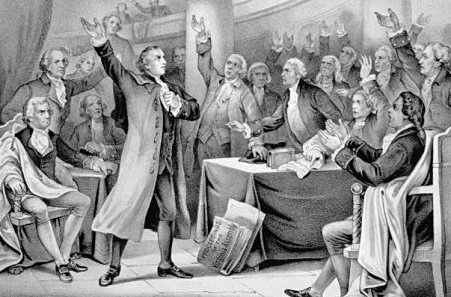
Founding Fathers

Elitism has earned an ugly name over the past decade or so. A sure way to accuse someone of having poor judgment or lacking real-world experience is to tar them with the “elite” label. The use of “elite” as a derogatory term has been most pronounced in politics. Political leaders sneer at elites - holding up underachievers as role models - while at the same time aspiring to become the elite of the political class. The “wealthy elite” are also villainized in political campaigns as people who don’t pay their fair share.

I would like to be elite. I like to say - mostly to myself or maybe to my immediate family - that I AM elite. It would be a shocking thing to claim or aspire to in a public conversation, though. Some of my elitism was earned: education, both formal and undertaken on my own, and some was just the lucky accident of my birth - I was born a Caucasian citizen of the wealthiest nation on Earth. Nobody likes to admit the fact that they have some claim to the status of elitism. The term has been damaged over the years.

I want to be elite, and I want others to want to be elite. In private moments I’m not ashamed of being well-read, or well-educated, or having a liberal mindset (in the open-to-all-ideas sense, not the political sense). I want to come out at the top of the heap. I think that the goal of a family, or a community or whatever group you choose to look at should be the creation of elite individuals: Jeffersons, Einsteins, Ataturks. You want people to rise above the average and lead.

I’m not there (yet). I’d like to be. To admit to wanting that would probably seem gross in most company, and I’m most comfortable making that claim on my semi-anonymous blog. We need elite people, and anyone who derides or attacks the elite is, well, an idiot. You can disagree with the particular ideas or approaches chosen by elite members of society, but in business, politics, science, art, religion, whatever area you choose to examine, you NEED an elite. It’s not the elite as determined by birth, or Ivy League education. It’s the elite chosen by intelligence; by drive; by perseverance. I don’t know when that became an ugly attribute in this country, but that attitude needs to disappear - and fast.

photo credit: INeedCoffee

have MBAs been devalued by the crisis?

Graduation Cake GuyWhen I went to graduate school, an MBA was still an achievement - it almost guaranteed getting the job you wanted and conferred an impressive status (at least in the business world) on anyone who held one. Consequently, the popularity of the MBA grew and grew over the last couple of decades. In today’s corporate world - at least in New York - you can’t throw a pencil in a conference room without hitting an MBA.

I found myself wondering yesterday whether the current crisis has devalued the MBA. President Bush is the first president with an MBA. No doubt many of the men (and don’t doubt for a minute that the overwhelming majority were men) who crafted the clever securities now causing so much commotion were MBAs, as well.

So will the nation see a drop in business school applicants, both from disgust with the horrible way in which these executives have handled the crisis (and before that, their companies) and due to fear of a vastly shrunken market? I think we will see that. I think this crisis will make a lot of young people wonder if Wall Street is such a great place to work. I think more college graduates will pause before assuming that they want to incur more debt just to get a degree to work in an industry in massive flux.

Only time will tell, of course… but I think an MBA today won’t be worth as much as it was even a year ago.

photo credit: CarbonNYC

Student Loans for borrowers with good credit. Rates as low as 7.88%. Borrow up to $25,000 to help fund your education.

when does intellectual curiosity stop?

From bookstatistics.com:

  • 58% of the US adult population never reads another book after high school.
  • 42% of college graduates never read another book.
  • 80% of US families did not buy or read a book last year.
  • 70% of US adults have not been in a bookstore in the last five years.

If you’re like me, you read that with a chill running down your spine. You read blogs, so you’re reading a lot. You like reading. You think other people ought to like to read.

One of my fondest childhood memories is reading “The Hobbit” along with my dad. We had a big illustrated edition - a lot of the cheesy Rankin-Bass stills, where Gollum looks like a frog - and he read it to me in installments. I don’t remember how many times we read it or how old I was, but I read “The Lord of the Rings” trilogy (on my own) before 3rd grade, so it was probably when I was 5 or 6. But my point is simple: I remember being almost insanely excited with the idea that another chapter was going to unfold. A picture would be painted in my mind - by me - and the next day another picture would be drawn. I would go to sleep in the bunk bed I shared with my brother, my mind filled with trolls and dragons and dwarves.

I read to my son a lot, and have done so since he was born. I’ve tried to with my daughter, with less success since every time I start to read to her my son runs over and insists on sharing (which means reading to HIM). But I think both kids have an early love of reading. I don’t read to them for any other reason than a long-term attempt to inspire a love of books in them. Books have been some of my truest and dearest friends throughout my life, and I think children need to learn early in their lives that a life can revolve around books without TV, video games or the internet.

Bubelah and I talked about intellectual curiousity this weekend, in relation to things I’ve said about a college education. I argue that for most people, college is a crutch. Their intellectual curiosity is sated by four years in college - they read, they take interesting courses, they graduate and 58% of them never read a book again. Bubelah thinks college is necessary for growth, and that college forces people to expand in ways they never would on their own. I say that college can only assist growth - intellectual curiousity, if someone has it, won’t stop with college. We didn’t decide the argument, but we did agree that there is no excuse to quit learning, ever.

I know my coworkers are weirded out that I sit and read a book in the office pantry while I eat lunch. They are doubly weirded out that I read history, or graphic novels, or fantasy/sci-fi. The idea of reading anything other than a newspaper or magazine seems trivial or immature to them. Even though I am not enamored of either of the major parties in the US, every time I hear someone (and it’s usually a Democrat) mocked for being “an intellectual” or “an elitist” I cringe. When did intellectual prowess or a curiosity about life become a characteristic to be mocked? I care about history, space exploration, politics, ethics, literature. I’m a pointy-headed intellectual - and I drink beer and love pro football, too.

Reading is the gateway to knowledge. Of course you can gain knowledge through experience, or discussion, or other avenues - but reading is so freely available and simple that it can only be deemed a great failure of any society that doesn’t encourage it as a core virtue. I’d like to see America become a place that’s proud of intellectual curiosity, but too often intellectual curiosity is mocked and belittled by people whose idea of culture is determined by TV executives. Knowledge should be a lifelong goal, not something satisfied by four years in college.

college student finance tips


This post is part of The Money Writers‘ college student finance tips group writing project.

Everyone likes to think that with the passage of time they become an expert. Simply by virtue of their own experience, they become an expert in an area that could be the subject of full-time study. That’s what giving financial advice to students seems like to me - but I’m going to give it a shot as part of a group writing project by The Money Writers. I only have three, and in all fairness it’s really only one idea broken down three ways.

1. Consider if you really need to go to THAT (or any) college. I’ve thought about this idea a lot recently. I have a relative who’s going to school for art. A very expensive private school… for art. Does that make sense? I suppose it might. Maybe you interact with other artists, you get to hone your skills. But do you need an expensive private school education in art? I majored in mathematics. I needed help - you need instructors to explain things. If you’re a writer, you need someone to teach you how to spell, writer gooder, and so on. If you want to be a dentist, you aim (I hope) on attending dental school. But if you want to work in accounting, trust me - the Big 4 are hiring just as many people out of state schools as private schools. You will all make the same. And if you’re an artist - maybe you should give a couple of years over to art before going to school. Just sayin’.

2. Choose a major based on your needs, not your idle ‘wants’. A recent commentator said that they needed to attend a $40,000 a year graphic design school. If you want to be a doctor, you can afford to gamble on taking on student loan debt. Your future earning potential is high. If you plan to be a high school teacher, you might want to think twice about taking on huge debt. Choose a major based on your needs - or more importantly, go back to step 1.

3. Don’t bite off more than you can chew. I imagine this is the simplest advice, but the most often ignored in our status-hungry society. If you cannot afford a $50,000 per year education - if you have to scrape and pull together every last dime - ask yourself: could you go to a less expensive school? Would it cripple you beyond belief? Will people revere your Yale biology degree and mock your Michigan biology degree? I doubt it. Take a look at what you can afford. Remember: your education will help you land your first j

I rejected a lot of prestigious schools to attend a state school and - very honestly - have never had a moment’s regret for my decision. My choice would not be for everyone. But in today’s world, with an uncertain economy, an unsure future and unrealistic expectations, I have to ask: wouldn’t the best financial tip be not to waste money on more education than you need?

Check out the rest of The Money Writers‘ college student finance tips:

photo credit: lucianvenutian

1 2 3 4