
Author Archives: Steve

IQ and wealth

I read an interesting article, “A high IQ is no financial guarantee”, on MSN Money today. There were a couple of key takeaways I got from the article, but you should read it before continuing. The author, Karen Aho, points out that you can’t draw any broad conclusions from the study… but I will! The study focused on baby boomers, since they can, for the most part, be looked at retrospectively in terms of savings and income.

My key takeaways:

  1. Saving money has nothing to do with IQ: “[people] with average and low IQs were just as good at saving money as those with high IQs.”

  2. Earning money does have something to do with IQ: “subjects earned an average of $234 to $616 more per year for each added IQ point, meaning someone with an IQ of 120 (top 10%) made $4,680 to $12,320 more than those crowded in the middle of the bell curve with an IQ of about 100.”

  3. Earning money has nothing to do with saving money: While those with above-average IQs were three times more likely to have a high income as those with below-average IQs, they were only 1.2 times more likely to have a high net worth.

  4. Nobody is really good at saving money: No IQ group had built up "a significant financial cushion." The median baby boomer’s wealth equaled 18.6 months of income, while the highest-scoring group, those with an IQ of 125 or above, had little more than two years of income saved.

  5. Money is not the only measurement of wealth: The colleagues of the study’s author, university professors, told him “We are incredibly ‘wealthy.’ We don’t work many hours, and we get to work on whatever projects we want [despite lower salaries and net worth]."

So to address each point:

Saving money has nothing to do with IQ

People are often confused about what IQ really means. From Wikipedia: An intelligence quotient or IQ is a score derived from one of several different standardized tests attempting to measure intelligence. IQ tests are used as predictors of educational achievement. Note that these tests are used as predictors of educational achievement. They do not, for example, test discipline, or creative ability or personality. Someone who has a low IQ but is highly disciplined, for example, might be a better student of engineering or mathematics than someone with a high IQ who doesn’t focus. Someone who has a great knack for spotting real estate deals though intuition might not have done well in biology class.

Saving money is more about temperament than educational intelligence. Since our education here in the US pays absolutely no attention to financial education, a high IQ might even work against financial education. People with high IQs might continue their education longer, deferring their entrance into the real world where they have to learn about managing their finances. I didn’t get my first real job until I finished my graduate degree at 24. People I know who didn’t go on to college had already been in the workplace for six years, dealing with all that entails.

Earning money does have something to do with IQ

Study after study shows that you can earn more money with a college education, which you are more likely to obtain if you have a higher IQ. Corporations and other large employers will tend to pay more to a college graduate, meaning earning potential is higher if your IQ is higher. I am not sure this is such a great thing. Are you better off working at a fixed salary as a manager for The Corporation with 5% raises over the course of your life, or being this guy who didn’t manage to graduate from college, but had a clever idea about selling software?

Earning money has nothing to do with saving money

I earn a lot of money. I spend a lot of money. Because I live in the most expensive part of America, my above-average salary gets swept away pretty quickly by my way-above-average-costs. I don’t spend unnecessarily, although as with everyone I could cut back in certain areas. But my ability to save is a function of my efforts to cut back on expenses where I can, not due to the fact that I make a huge salary. I maxed out my 401(k) deductions (which is a set amount, not a percentage of earnings) 15 years ago when I was living in a much cheaper city, making about 1/5th of what I make today. So I saved just as much when I was earning much less. That has more to do with my interest in saving than it does with my earning ability, because as a percentage of my overall income my savings rate is drastically lower than it was – my savings rate has declined as my income has increased.

Nobody is really good at saving money

This goes without saying, almost. The US has a terrible personal savings rate. I think the statistics bear out that although certain individuals are better than others, as a whole our nation is not good at saving money, regardless of one’s social status, intelligence, hair color or favorite TV show.

Money is not the only measurement of wealth

I don’t think this point can be repeated enough. There are other measurements. Is someone who works 100 hour weeks his whole life until he drops dead of a heart attack at 60 truly wealthy? Is a painter who loves to paint but can’t afford the newest iPhone really poor? These are philosophical questions, of course. But a person who has a pension guaranteed for life is in many ways wealthier than a person who has all of their savings for retirement in the stock market. The pension, of course, can go bust, but assuming it doesn’t I’d rather have a small guaranteed payment rather than a wildly fluctuating amount. Peace of mind is priceless, isn’t it?

It’s a good article. I don’t think there’s anything surprising there – street smarts have trumped book smarts plenty of times throughout American history – but it’s interesting to see those study results in one place. There’s hope for all of us!

aging gently

As I spent some time in an assisted living facility last week I thought about aging and money. Here are the two most important concepts I came away with:

  1. At the end of your life, money and things are not important. Having friends and family and a rich store of memories will be more important than whether you ever owned a boat. This is the Hallmark Card thought that people bring up when talking about old age and death.
  2. That having been said, the end of your life is a lot nicer if you have some money. I’m not talking about nicer in the sense of having HBO. I’m talking about having a nurse who’s going to change your bedpan when you ring the bell rather than being in an institution where they let you sit in your own crap for three hours because they are understaffed.

I really cringe from time to time thinking about how much money I am hoarding for some far-off "retirement". Unless my savings rate and return rate spike up dramatically in the next 10 years I’ll still work until my mid-60s regardless of what I do now. And of course I could get hit by the mythical bus any day, rendering much of my planning for my sunset years irrelevant (except of course in that these savings would help out my family, but I have life insurance for that and frankly even with savings and insurance Bubelah would have to go back to work). So the ugly little thought creeps into my mind that maybe I should be enjoying this money today. Not buying the latest plasma TV, necessarily, but spending it on a fancy private education for my son, or on illuminating vacations (pyramids, Great Wall, safaris) or on a beach home in Florida. With the amount of money my wife and I save it wouldn’t be an insignificant amount of extra money if we stopped saving tomorrow. That extra money would alter our lifestyle.

However, I think about what I saw last week and realized that if you don’t have lots and lots of money, things can go south quickly. I saw a very nice assisted living complex, filled with relatively happy looking seniors. There was a very pleasant restaurant-style cafeteria, activities and a very pleasant physical complex with bright halls, cheery rooms and clean surroundings. All of this comes at a price; my best understanding was that it runs more than $5000 a month in an area of the country where that is no small amount. To put that in perspective, to generate $5000 per month in net income would require a nest egg of $1,300,000 earning 6% interest (no sure thing unless you want lots of risk). “That’s not so bad”, you think. That means $5000 for basic care. No drug co-payments, no hospital stays, no extra assistant care - all of that is extra. “That’s fine, Medicare will cover that,” you say. I hope you are right, after all of your “fun” 60s and 70s and giving gifts to the grandkids and traveling to Spain and whatnot, just for a place to live. $1,300,000 in the bank when you are 80, for the sake of argument.

All of that might not even be that terrible except:

  1. One or both of us might live far longer due to advances in medicine. Already people are living longer and longer due to artificial hearts, drugs, surgery, you name it. If I live to be 105, or 20 years past what I expect, won’t I run out of money? What happens when I’m 97 and the bank account is tapped out? I hope my son or other potential future children could help, but I may need care past what they could easily provide at home. What then? What if something even more ridiculous happens in the next 20 years (a cure for cancer, for example) and people start living to 120? 130?
  2. One or both of us might have health issues, draining our savings. This might be as simple as needing additional nursing care for non-life-threatening conditions, or as awful as a long lingering illness.

So let’s assume that $2 million (a random large number) would last for 30 years after I reach 65 (remember, 20-25 years for me and 30-35 for Bubelah). How is it even remotely possible to think of saving for 40 years, 50 years of quality living? Is it possible? I sometimes doubt it, particularly considering costs may dip at first when we’re in our 60s and in decent health (assuming we don’t take that super-luxury cruise to Europe), but will probably spike back up again as health problems mount. Could you ever start drawing down on principal to boost your monthly income? Even if you don’t, the principal will rot away with inflation. 40 or 50 years is a long time to hope for $1,300,000+ to carry you. You would have to draw the principle down and hope that the month you drew out the last $18,000 (inflation, remember?) was the month you died.

I don’t know what the answer is. Maybe the answer is spend it while you’re young and hope that this country does something about elder care before you get there yourself…

free cool stuff

I thought in this post I would highlight a few products that have made my web experience a lot more productive and fun.  They are in no particular order, and it’s certainly not an exhaustive list.  I know I have many Google products on the list, but they are quite dominant these days in terms of very useful free software.  If you are looking for ways to save money – and you always should be – these are a few ways you can quickly and easily jettison your expensive applications from companies like Microsoft and Norton.

Open Office:  What can’t you say about Open Office.  I used to fork over hundreds of dollars for various Microsoft apps every couple of years when they upgraded their buggy operating system.  No more.  Open Office has word processing, spreadsheets, presentations, databases and more.  It is very stable and very similar to the Microsoft Office suite.  You may have to relearn a few keystrokes if you’re a keyboard person like me – instead of Ctrl-K to insert a hyperlink it’s Alt-I-H.  But these are easy to overcome, and Open Office works very smoothly.  It seems to crash far less than Microsoft’s products.  They can save anything in Microsoft format or a million other formats, including PDF.  I can’t see why anyone would choose to use the Microsoft product after using Open Office for a day or two.

Google Documents and Spreadsheets:  I have to be honest, these are a bit buggy for me, and the features are still very limited.  I can imagine eventually these will become stronger, and the online aspect is great as long as you can access them. I only use them for very basic files that I might need to access from anywhere.  I keep a copy of my phonebook in here, for example.  I keep a few ‘goals’ documents here, too.  However, an annoying number of my clients block Google docs so I don’t rely on it for my primary word processing and spreadsheet needs.  I probably would if I could, though, just for convenience’s sake.  I suppose the possibility of shifting confidential information around on the Internet worries some companies, although I’m sure a million sensitive documents get copied onto USB drives and sent by email to personal addresses every day.

Gmail:  I recently shut down my Yahoo! Mail account after using the same email address for almost eight years.  Yahoo! Mail has a lot to recommend it – unlimited storage, a neat little Outlook-like interface and a nice RSS reader.  However, the new mail beta crashed too often for my taste, and the new interface seemed like a step in a very unimaginative direction.  They basically said “let’s take Outlook and put it online”.  The web is moving in a different direction – tagging, what I call “light touch” interfaces and simple, pleasant design.  Yahoo is getting away from their original simplicity and creating a feature-heavy, complex interface for mail.  Gmail, on the other hand, allows multiple tags for emails to help keep them organized, and the search function has rendered any need for folders obsolete.  Need to check that email you received four months ago from what’s-his-name about the meeting at the Starbucks on something street on June 26?  Just search on “Starbucks” and there it is.  I have been using gmail for several months now and the tagging and search functions are incredibly useful.  I know it has other features, such as integration with Google Calendar and Google Maps, but I don’t use them as much.

Google Earth:  A massive timewaster and not terribly useful, but this is a sure crowd-pleaser.  I love to sit and ‘fly’ from one remote location to the next; from Miami to Red Square to the Forbidden City to the South Pole to Ulan Baator.  Try zooming in on your home, or your office, or even looking for famous landmarks.  It’s a lot of fun, although the practical application eludes me.

Firefox:  I tried using Internet Explorer for a while when version 7 came out.  It was an improvement, but Firefox has one tremendous advantage over IE:  it is open source and therefore anyone can develop add-ons for it.  It also works better with sites like Brip Blap.  I use a dozen different add-ons, and every one of them has greatly enhanced my web browsing experience.  LeechBlock is a great add-on, as are THIS and THIS.  Firefox is less susceptible to hacker attacks (for now) and if you aren’t using it, you really should give it a try for a while.

Picasa:  Unless you are a professional photographer, this photo editor/organizer is all you need.  It has a very easy-to-use interface, and the basic fixes like cropping and red-eye removal are simple to use.  I find that it’s the only photo editor I need 99% of the time.  Occasionally I might like to do something a little fancier, but not at the price of buying Photoshop.  I have heard of a free photo editing software (open source) called gimp but I’ve never tried it so I can’t speak to it.  It’s quite popular, though.

Miniclip.com:  Who needs a Wii when you have this site?  I am no gamer.  For some reason that whole lifestyle just passed me by.  I played Doom II and Quake when they came out, and I enjoy Strategic Commander on my Palm, but for the most part I’m not that ‘into’ video games.  This site, though, has a few simple Flash games that I find really entertaining to blow off steam for ten minutes.  Try Samurai Sam or On The Run.  Simple and fun and most importantly, free.

Grand Central:  I am a very light user of this service, but so far it has blown me away.  If you aren’t familiar with it, it is a “unified number” for all of your phone numbers – home, work, office, even your hotel or temporary conference room.  If someone rings your GC number, all of your other phones ring – but that’s not the really amazing feature.  I can also set certain phones and certain voicemails to activate if certain people call.  If John from work calls, GC will ring my work and mobile phones from 9 to 5 but send him straight to voicemail after 5.  If Bubelah calls, every single phone I own will ring.  If someone I’m trying to avoid calls, I can have all of his calls sent straight to voicemail.  The possibilities are endless.  I’m sure that in the future I’ll have one number, my GC number, and all of my other phone numbers will be completely irrelevant.  There are rumors that Google is acquiring GC, which is great – one more way to give myself and all of my information over to Google.  Google has acquired Grand Central.  I figure as an early adopter they will spare me and my family when they seize control of Earth (not in an evil way, of course).

eVoice:  I have been using this service for years.  They give you a free number, although if you want a specific area code you’ll have to pay for it.  I use this number every time I apply for something:  an account with a random web service, a credit card, even an account with a job board.  This helps me screen calls and keep non-personal phone traffic from hitting my cell phone minutes or disturbing Little Buddy when the home phone rings.  You receive a small attachment in your email account and you can play it with their proprietary player or with QuickTime.  I wouldn’t recommend using it for anything you need to check quickly, since you have to be able to receive emails to hear your voicemails, but it’s great as a ‘second’ phone number.

Grisoft Anti-virus:  I have been using this free anti-virus software for years.  It is non-obtrusive and has – knock on wood – provided complete and flawless protection for several PCs over the last few years.  I don’t know how they do it, to be honest, but it’s a very good little program that does exactly what it advertises.  In my experience paid anti-virus programs (I’m thinking of Norton’s products) often had trouble performing self-updates and occasionally struggled with new viruses as they appeared.


On a final note:  when I first set up Brip Blap, I noticed that I couldn’t get my ads for Google AdSense or Amazon.com or blueeyetree.com to show up.  I tinkered with the code for a day before I suddenly remembered that I had an adblocker running.  I hate pop-up ads and noisy flashing motion ads, but I realized that by blocking static text ads I was only hurting myself.  The way sites like the New York Times remain free is through advertising.  If you want to continue to read sites like those, or enjoy Google apps, you probably should suffer through the ads, or else they will have to start charging someday in the future.  Personally I’m still blocking pop-ups.  I wouldn’t want a pop-up on my TV, obliterating my show until I hit a button on the remote.  Ads between segments of the show, fine.  Text ads to the side and around content on the Internet, fine.  But consider that advertising keeps these sites free when using any of the services above.

So what did I forget?  There are many others, of course - Remember the Milk, WordPress, Poisson Rouge, Wikipedia, etc. etc.  You could go on forever.


How to lose 100 pounds, part 1

If you like this article, you can also read my article 101 thoughts on losing 100 pounds.

In 2000, I weighed approximately 315 pounds. By 2006 I weighed 200, although this year I’m back up to 220 (baby fat – nothing like having a baby to ruin a diet/exercise plan)! But I have lost 100 pounds off of my maximum weight and kept it off. I wouldn’t say it was easy to do, but the rules to do it were very, very simple. There were three categories, and I’ll cover the first, diet, in this post. The other categories were exercise and overall discipline.

Diet

I went on the Atkins Low Carb Dietlow-carb diet

I think the problem most people have with Atkins is (a) your food selection becomes fairly limited and (b) they don’t follow his instructions. I lived that book’s instructions like they were gospel. Read the book and follow its instructions first, but I have a few tips in addition.

1. Eat lots of fish and chicken. You can do a lot of different things with fish and chicken in terms of preparation and spices. Turkey, beef and pork are a little trickier to work with. I love turkey so I didn’t mind eating it a lot, but I largely avoided beef and pork.

2. Keep lots of cheese for snacking. I like salty foods, so my biggest snack issue was dropping the Doritos. Cheese works much better as a snack food than meats or veggies.

3. Don’t ever touch bread or pasta. After I had been on low-carb for a while, “low-carb bread” and “low-carb pasta” started coming out. I still avoided them. I think part of the low-carb lifestyle is just that, a lifestyle. Reintroducing breads and pasta just puts you back in the mindset that they are legitimate food choices. They aren’t, ever, when you’re trying to do Atkins.

4. Drink a lot of liquids and if it helps curb cravings diet soda is OK. Atkins says you shouldn’t drink diet sodas – it enflames your sweet tooth and splenda/aspartame have unknown effects on the body’s chemistry. However, I still drank diet Coke when I was on Atkins and it helped with any cravings I had for sweets, so I think it’s a good substitute. I did introduce my 8 X 8 habit: 8 ounce cups of water 8 times per day. I was never a big water drinker prior to going on Atkins, but trust me – if you drink enough water, you will be full at least for a while.

5. Ricola

6. Don’t be embarrassed! I was a fervent evangelical for Atkins. Some people thought it was funny that a man was dieting, but I viewed it as something I could be proud of, particularly after I lost 100 pounds. Dieting shows willpower and determination. Fatness is a by-product of lack of will. I know, I know, some people have biological predispositions to obesity, yada yada. I am sure that’s the case, but 99% of us are just lazy.

7. Learn to cook. To survive I had to learn to cook. You can’t go on Atkins and eat hamburgers and cheese for two years. I became a bit of a gourmand during this time, whipping up all sorts of fancy fish dishes, chicken-and-veggie mixes and a lot of ‘modified’ dishes. You would be surprised how many good recipes can easily be altered by substituting diced cauliflower for rice, or shredded peppers in place of pasta.

Try following these steps in addition to the book. Exercise and mental discipline are also important steps which I will cover in future parts of this series.

how to save money on air conditioning

In 1997, the average home in the Northeast spent approximately $1,700 per year on energy. In the Department of Energy study, this spending was broken down into four categories: Space heating, electric air-conditioning, water heating and appliances operation. I was surprised by the ratios, since my original thought for this post was to talk about keeping air conditioning costs low. According to their study the percentages for these categories broke down like this:

Now my idea for this post was going to cover ways to reduce your air-conditioning costs, but this study started me thinking (always a dangerous undertaking, because once I emerge from days of introspection, reading and agonizing over this data I’ll be ready to make a tentative decision and then the trouble starts). My thoughts on air conditioning reduction are still valid, I think, as a lifestyle choice, and later I’ll give my thoughts on researching things before leaping into action.

Air conditioning

I have found that air conditioning is one of the simpler things to ease out of your life. During the winter in the Northeast air conditioning is a non-issue. The temperature even at its most freakish won’t climb into a range requiring any air conditioning for six to seven months out of the year. Spring and autumn are usually mild and don’t require air conditioning, either. We live about 50 feet from a river, and the breeze coming off the river is usually quite brisk year round, especially during the day. It usually gets very still as the river cools at night, and that’s one of the few times air conditioning might be needed, particularly if the tide is ebbing out.

During the summer, usually about three to four months, air conditioning may be necessary. We have the same breezes but temperatures rise into the mid 80s; seldom higher, but occasionally we’ll get some 90s. Three years ago the summer was so mild it seldom reached the 80s. Last year we had a few terribly hot weeks. In general, though, we don’t have the extremes of temperatures you find further inland or south.

Our house is a townhouse, but we’re lucky in that we have a corner unit and therefore windows on two sides. This provides a cross-breeze, which is very useful. We have a large green space across from us rather than more townhouses, so the breeze is not impeded.

Even with all of this considered, my first instinct has always been to crank the air conditioning to 68 or 70 all summer long. Despite the fact that I would love to have temperatures as high as 74 or 76 in the winter, I inexplicably want colder temperatures in the summer. Bubelah wants it warmer in the winter, warmer in the summer. Little Buddy so far doesn’t seem to care, but for a toddler’s sake you don’t want to keep the house at 62 (although I suppose if you wanted to dress him up you could).

But we did realize that we could keep it much warmer and accomplish five things:

  • Reduce our costs. This was the obvious benefit, although as I mentioned in this post the benefit was less than I imagined it might be. However, the spending on keeping the house icebox cold was pointless, and every little bit saved helps.
  • Reduce our energy usage and help the environment. We don’t participate in wind energy programs (yet) so presumably our energy comes largely from non-renewable sources. We have a fairly energy-efficient air conditioning unit, but it still requires a substantial amount of energy to run constantly.
  • Keep fresh air in the house. This is sometimes debatable, since the river can get funky, and we do live close to New York which sometimes produces odd smells all its own. For the most part, though, outside air is constantly flowing through the house rather than being constantly recirculated through an air conditioning system. This makes us feel better, although I suspect it’s largely psychological. Since we have a high-end ionization filter on our central air pump (or whatever it’s called) the air is probably technically cleaner when the air conditioning is functioning than when the windows are open. I still seldom meet people who prefer the closeness of shut windows when there’s fresh air to be had.
  • Reduce noise. The air conditioning is downstairs but it does whoosh out of the vents when it runs. We trade that rushing noise for outdoors noise – birds, street noises, children and other suburbia background buzz. It makes you feel more connected to your neighborhood.
  • Make ourselves generally more comfortable outdoors. The transition from indoors to outdoors or vice versa can be rough if you have massive temperature differences. Everyone knows how nice it feels to walk from the 90 degree street to the 70 degree room. This feeling lasts for a few minutes, then it feels uncomfortable as your sweat chills and your lungs struggle with dry, air-conditioned air. If the air humidity is slightly less and the temperature is slightly less indoors, the transition isn’t immediately as pleasant but in the long run it is much nicer. The reverse is true, because when we go out with Little Buddy there’s not the same sense of being blindsided by humidity or heat when you step outside. I find I enjoy sitting on the balcony much more even when it’s hot.

We did all of this by following a few simple steps:

  • Buy a programmable thermostat. If you have more than one thermostat, get a programmable replacement for each. Our house has two, and we can keep the upstairs air-conditioned while keeping the downstairs windows open, which is convenient when Little Buddy goes to sleep and needs cooler air to relax.
  • Put up light-blocking shades, backed by thin sheers. The sun can rapidly heat up your house, so having heavy drapes on southern and western exposures really helps deflect the worst of a hot day’s sun.
  • Keep the temperatures reasonable. Don’t try to sit out an 89 degree day. Use your air conditioning, but keep it at 76, not 72, because you can “re-addict” yourself.
  • Keep all of the windows open. This might seem obvious, but throw open windows everywhere, even in rooms you won’t be in. This keeps the air flowing throughout the floor or the house. If you keep windows closed in just one room, that one room will get stuffy and unpleasant, and tempt you to turn on the air conditioning to “pump it clean”.
  • Take a shower before sleeping. If you take a cool, soap-less shower before sleeping it washes off sweat and cools your body down, making it easier to sleep. This is still my toughest time with the air conditioning, because I am used to sleeping in an arctic chill with heavy blankets. Taking a quick cool shower makes it easier for me to sleep in a warmer room.
  • Keep the lights off. This goes for other appliances, too. Appliances use 40% of your household’s energy, so that generates a lot of heat. Some, like the refrigerator, have to stay on, but consider whether lights and TVs and whatnot need to stay on. Even CFLs generate some heat, although far less than incandescents.
  • Don’t backslide. Don’t think one day, just for a break, you want to sit around in the 60s. If you want cold, go to a movie or a mall. But if you start pulling the temperature back down in your home, you may get lulled into inaction sitting around in a freezer!

Don’t forget if you have a toddler to ensure that all of the windows are proofed against falling out and that any balconies or patios are secure. We are lucky because our two balconies have railing that makes it impossible for a toddler to squeeze through, so Little Buddy is free to come and go on the balcony while we sit a few feet away in the living room.

This is one of those win-win changes you can make. You will feel better, save money and help the environment. The only possible downside is if you’re a sweaty person (like me) you may have to go through more than one shirt per day.

things I learned from my grandparents about money, part 1

Most of my relatives have some very different ideas about money, and by relatives I am including the wide range from my wife to my parents to my in-laws, etc. I realized a long time ago that it is very easy to pick out the flaws in other people’s philosophies or actions while failing to recognize them in your own thoughts and actions. However, I still find it a fairly useful exercise to try and determine where people make good decisions and bad decisions. Even more important is trying to understand the ‘why’ behind those decisions.

My mother’s parents (my grandparents), for instance, have always been very frugal. They were both raised on farms in the 20s and 30s and suffered through the Depression. My grandfather left home to join the Army pre-World War II, serving in the horse cavalry (hard to believe the US still had a horse cavalry less than 70 years ago, isn’t it?)
Here are some of their views towards money that I think are interesting, both good and bad, and my take on them.

  • Investing, a good habit. My grandfather was an early fervent believer in investing. Coming from a rural background and suffering through the Great Depression you might expect him to be very wary of investing, but he was quite the opposite. He invested heavily in the market, and on a schoolteacher’s salary did very well over the years. He did this although he had a state pension and could have chosen to spend that money. From him I learned a very conservative study-buy-and-hold approach. Although I didn’t know it at the time I learned it from him, his approach was basically the same as Warren Buffet’s. While it didn’t make my grandfather a billionaire, it did make him a huge ‘extra’ retirement fund on top of his pension and my grandmother’s.
  • Never selling, ultimately a bad habit. My grandfather maintained an almost emotional attachment to some of his stocks and held them year after year, even in times of declining prices, shrinking dividends and their own advancing age and deteriorating health. They saved these stocks thinking they could pass them on, but as they have moved into more and more expensive housing (nursing homes are much more expensive than regular apartments, obviously) it has become obvious that all of that money will be gone soon, regardless. Had they moved it into a savings account paying 5% ten years ago they could have been earning steady income.
  • Never really spending, good and bad. Although they amassed such a gigantic fortune (relatively speaking) on retirement my grandparents never really spent much. They constantly talked of wanting to pass it on to my mother (an only child) and my brother and myself. They never traveled, although my grandfather dreamed of returning to see a peaceful Germany. They did ‘live large’ in some senses - they ate out almost ever day, they bought new cars for cash every few years while they could still drive and they were almost insanely generous to my parents and my brother and myself. They gave us stocks, cash and other gifts for years. However, it is hard for me to look back on their 20+ years of retirement and think that they never really did much after retiring. I know that part of that is my perception, since I love overseas travel, but I am not sure retirement was meant for watching TV and eating out. That’s a judgment each person has to make individually, I guess. But when my mom was younger and living at home they were very frugal, and even late in life my grandfather’s frugality could be amazing. A heavy, heavy smoker for his entire adult life, he quit cold turkey one day because he thought cigarette prices had finally gotten to high - and hasn’t smoked in 15+ years now. He never worried about the health aspect as far as I know, but paying $3 for a pack of cigarettes instead of $2 was apparently one dollar too much.
  • Avoiding debt, extremely good. My parents and grandparents gave me one gift that I realize is invaluable after I read many personal finance blogs: the fear of debt. I have been convinced since an early age that going into debt is practically a mortal sin, a stain on your character, a flaw. While I think it may have been overstated a bit, this philosophy has made me somewhat unique in a sense: I have never carried a balance on a credit card, EVER. I have had only two debts in my life: a car loan one time and a mortgage on my current house. Other than that, I have never bought anything I couldn’t pay for with my existing funds. So debt has never been a headache for me, which is a great gift.
  • Charity begins at home, mixed. I know this may run counter to many people’s beliefs, but another closely held belief of my grandparents was to take care of themselves and their own before others. This philosophy meant that there was no ‘automatic giving’ to charity until everyone in the family was taken care of. They gave (and still give) to their church every week, but I am sure without ever having seen it put to the test that had I been in need for some reason they would have given that money to me, instead. I know this is a somewhat selfish approach, but I think it’s right. Give when you are able. I do not subscribe to the Christian teaching that I should give ALL I own to the poor, and apparently from the number of Mercedes I see in church parking lots I’m not alone in rejecting that teaching. It doesn’t mean you can’t give to charity - I certainly give to several children’s charities - but take care of your family first.

Those points are really just highlights. The important lesson to remember is that anything your family or your friends teach you about finance is valuable. Sometimes you may learn by avoiding their mistakes, sometimes you may learn by taking their advice to heart - but it’s all learning. From my maternal grandparents, I learned to save and to avoid debt but also that sometimes you need to spend money, too, because there ARE things and experiences in life worth the money. The truly important thing was never the money, it was the security the money bought, and being able to give back to their family, that mattered to them.

why I will not live in the northeast forever

A constant topic of conversation I have with my wife Bubelah is where we want - or should - live. We live in a suburb of New York City (the only major city growing in the northeast). Our cost of living is horrific. We have a three-bedroom townhouse that cost just shy of half a million dollars in 2004, pre-boom. Our house would go for almost $600,000 today. I think this topic goes well with an ongoing debate at The Simple Dollar.
When we bought the house, we received an abatement. For those of you not familiar with New Jersey’s blood, er, property tax, municipal governments often give a break to new construction for a set number of years. The way it works is that our house is taxed at the same rate as any other house in our municipality, but the assessed value is reduced by a set percentage. So a house, having been assessed as being worth $400,000, will be taxed as if it had been assessed as $300,000. This tax treatment will continue for another 4 years.

However, once it ends, our property tax will leap upwards. How much depends on the rate at the time and the new assessment. This situation wouldn’t be so bad if not for the fact that we already pay almost $700 per month in property taxes, plus over $200 in association fees (road upkeep, lawn upkeep, snow shoveling, etc. - not a bad deal, actually).

In five years, therefore, we might be paying approximately $1200 per month in taxes and fees. This is before our mortgage of almost $2000 per month. This means that simply to keep the house my after-tax income must be $3200 just to pay for the house. Before paying the utilities, for food, for diapers, for anything else - $3200 after tax or the first $50,000 of my gross income per year goes to housing costs. If we ever paid off the mortgage, we’d still have $1200+ per month to pay for all eternity.

All of this might not be so bad if it wasn’t for the fact that the property tax goes to service municipal debt, a failing school system, broken roads and awful municipal services. We have only two municipal parks in a city of a half million, potholes litter the roads, and large areas of the city aren’t safe after dark. We have concluded that the public schools are not an option for Little Buddy.

My point is that we must really, really, really love living near New York to put up with all of that, right? There are other considerations - Bubelah’s extended family all live in New York, my parents are nearby, and we desperately hope for a continued gentrification of our city (and it is happening in fits and starts). But are we crazy?

Consolidating accounts

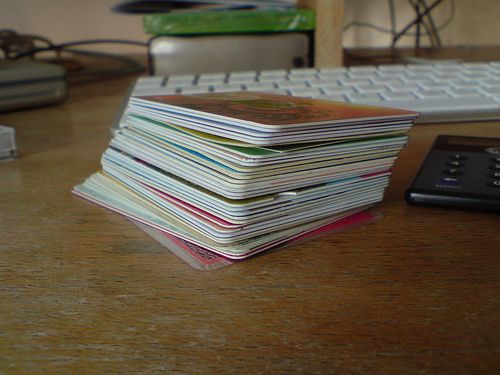
stack of credit cards
Creative Commons License photo credit: kalleboo

One of the best financial moves I made had very little actual net worth impact, but significantly improved my quality of life. After Bubelah and I got married, we did a quick inventory of our bank accounts, credit cards and brokerage accounts. I don’t remember the exact numbers, but between us we had at least four bank accounts, 20+ credit cards and approximately 12 brokerage accounts (and I’m including company 401(k) plans, IRAs and so forth). I had three direct-investment stock plans where the stock was held by the company, too.

We decided to consolidate to two banks, two brokerages and effectively to four credit cards. Why? Here are our reasons:

Banking

We chose our bank for our business and personal checking for two reasons: they have a large number of physical locations in the New York City metropolitan area and their account fees were reasonable (basically free checking). I could not think of any particular reasons to go with another bank, simply because we saw their branches everywhere, and in particular several convenient to our home. The fees were fine, because as long as we maintain some reasonable minimums (approximately $500 per account) we don’t pay anything. We don’t receive interest but we try to keep a bare minimum in these accounts.

We chose an online bank for our emergency fund and other savings. We could just as easily have used ING or Citibank, but at the time we decided to open an account HSBC was offering the best rates. As we have extra money in the checking account we transfer it into our online savings account. HSBC (similar to other online high yield banks) has a structure friendly to people with frugal natures. The account pays a very respectable interest rate, and it takes some small effort to withdraw funds, meaning spur-of-the-moment withdrawals are unlikely. We understand that the money in this account is not returning what our stock accounts are, but this is the conservative, worst-case scenario money so we don’t mind have a stable rate of return in exchange for very low risk. You can learn more about HSBC’s savings account here. I highly recommend it.

Brokerages

We went with two separate brokerages for our accounts. We ended up going with two brokerages for several reasons:

  1. I started moving my brokerage and IRAs before Bubelah did. I started this process because I was unhappy with my brick-and-mortar brokerage’s high commissions and awful online experience. The broker I chose, Ameritrade (now TDAmeritrade) had much lower commissions ($7.95/trade) and a much more pleasant online interaction. I am not a day trader anymore, so the commissions were not a critical factor, but I don’t rely on a broker to make trades for me and so I felt little need for expensive ‘actual person’ trading. Bubelah chose another low-cost online broker with similar commissions.
  2. We had to keep separate IRAs so we thought it would be simpler to keep one brokerage account and several IRAs linked without a lot of confusion over which account belonged to whom.

Both of us had a vague fear of putting all our investment assets in one basket. While I have no reason whatsoever to worry about either of these firms, we didn’t want to be in a position where everything we hoped to use for retirement was held by one (virtual) company.

Credit cards

Our consolidation of cards was a mixed success. The easy part was the store cards. We canceled all of them. We kept one card as our ‘main’ card. We had to keep a debit card associated with our bank account, and I had a flexible spending account card through my work. Other than that, we kept three more credit cards, for different reasons.

  1. A card for business purposes. Bubelah runs an online business so we decided we should keep any purchases necessary for the business on a separate card. We have a separate checking account at our bank, too.
  2. A ‘legacy’ card for Bubelah, because of the points. She had been using the same card for years and had accumulated a large number of points/miles on the card, and wasn’t willing to lose them all. Plus, it was in her name alone and we decided it made sense for us each to have our “own” card which would not be a joint account.
  3. One card in my name only, for the same reason - I wanted something in my name only, because other than this card every single thing we own is joint.

The biggest benefit to the whole process is saving time and increasing awareness of spending. When you get one huge bill each month and know you have to pay it off in full, it makes you think twice before spending. We always pay the entire balance each month, so it’s almost like spending cash. However, you get spreadsheet downloads showing when/where/what you bought, and you get points which we have used to save thousands on hotels, flights and so on. We have put almost all of our spending on the card, including automatic charges (cell phones, utilities, etc.). I think it helps to see all of your spending in one place, and it greatly simplifies bill-paying at the end of the month. We only write 1 physical check each month. All of our other spending is through automatic bill payment on our bank or through our main card. Even the mortgage is automatically withdrawn.

If you haven’t already considered consolidating your accounts, consider this: it will take a tremendous amount of time to track down all of your information, move your accounts (particularly investment accounts) and close unneeded ones, but the time savings on the other end of this process are tremendous. Where once we spent hours flipping through paper bills for our dozen credit cards and trying to figure out which account to pay it out of, we now just automatically pay our one credit card and get two statements for our investments. We have a clearer picture of our spending by seeing it summarized in one credit card per month. I believe anyone could benefit from making their finances simpler and reducing the time spent on them.

Landlines

I wonder how long it will be before I can get rid of my landline. It’s a source of constant irritation to me. It costs almost $60 per month for the cheapest flat rate program Verizon has. It includes unlimited long distance and local calling.telephone

This seemed like a good idea when we moved from New York to New Jersey. Since Bubelah’s family lives in New York and mine in Virginia, we made a fair number of long distance calls. However, with all of our families on Cingular, oops, AT&T, we get mobile-to-mobile minutes free.

So why don’t you get rid of the land line and just use the mobile phones?” you may ask. Good question. First and foremost, the sound quality on the Samsung phones we have is really poor. They are little flip phones and you have to bellow to be heard. If we had better phones we might not have such terrible sounding connections. Then again, that may be wishful thinking and it may just be the service.

Second, we have a family plan with limited minutes. I use my cell occasionally for business, and we have five people on our plan using 500 minutes per month. I imagine we don’t use our landline that much during the day, but it still might strain our minutes.

Third, I remain distrustful of internet phone services. I really have to see one someday, but no-one I know uses this yet. If I saw it and used it and it worked I might be able to get it myself, but I’m afraid it will sound like Skype, the equivalent of using a walkie-talkie for a conversation.

Finally, and in some ways the most important but easiest to overcome problem, I remain worried about 911 calls. Landline 911 calls go right to, well, 911. I have the police emergency number programmed in my cell phone, but I have never ‘tested’ it and I remain concerned that in an emergency a mobile won’t be enough. I remember very well from my childhood and from 9/11 times when everything went out, but the phones stayed on. Electricity out because of snow/lightning/blackouts? The phone still works. All mobile phones dead because of swamped communications during 9/11? Landline still worked, and I lived in lower Manhattan, the heart of the storm.

I guess in this instance I’m just not thinking clearly. We plan to upgrade phones soon, primarily to get features that we need with a toddler around. “What does having a toddler have to do with your type of phone?” Well, try carrying a toddler around while talking on your flip phone. Try talking on your flip phone around a toddler who loves phones and yells if you don’t give it to him. We really want Bluetooth phones, or at least speakerphones, so we can go hands free easily in the car or while pushing his stroller or even while chasing him around the house.

So hopefully a new phone will have a better connection and interface and we’ll be able to finally kill off the landline and save that ridiculous $60 per month. I really wonder what the future is for landlines, because I don’t see what they can do faced with this.

Health, wealth and social responsibility

I fight a mental battle over health, wealth and social responsibility all the time. Let me give a brief example. For my son’s room, we bought some blinds. These blinds were behind the curtain, and just there to block out the early morning sun so he could sleep a bit. After a while we realized they weren’t doing a good job. They were white, and thin, and didn’t block the bright blast of the early morning sunrise.

So we went and bought a second set of blackout shades. I took down the blinds and replaced them, and the room is much brighter. Here’s where the battle begins.

Health: I really want to de-clutter the house. I have no other windows where blinds would be particularly useful. Result: Throw out the blinds.

Wealth: I may need the blinds someday in the future. This exact situation has happened before - I threw out something and then needed it two months later and had to buy a new one. Result: Store the blinds somewhere in our cluttered storage room.

Social Responsibility: I may need the blinds in the future, but I doubt it. Maybe someone else needs them - maybe a neighbor, a family member. Throwing them away just adds to a huge trash mountain somewhere on the eastern seacoast, a thought that makes me sick. Result: Try to give the blinds away, probably with limited success (they are not heirloom blinds, after all) and they sit in the storage room.

Before I go any further, I know the answer is that I shouldn’t have bought them without thinking more about it in the first place. But it really fulfilled a particular need, they fit the window perfectly and my honest, reasoned thought was that all we needed was a light diffuser, not a blocker. I didn’t count on Little Buddy being such a light sleeper.

This mental battle is played out again and again. I know throwing out clutter adds to garbage. I have 10 old black binders I have not used in 5 years. I have no need for them. Yet I keep them, because I hate thinking of them sitting in a trash heap somewhere. However, the clutter they create is really annoying. Clutter ruins mental (and even impacts physical) health in my opinion. Yet throwing out the clutter may be wasteful, and it’s certainly not socially responsible.

So given a situation like this, what to do?

I try to take this approach these days: if I cannot instantly come up with a use for it, I have to throw it away. I kick myself about it, but throwing it away now or 10 years from now has the same end result for the environment, but very different results for me personally. And when I throw away big items I will think long and hard before buying my next big purchase. However, I think the battle will go on and on as long as I continue to buy new things. The secret is not to buy ANYTHING new, ever, but that’s hard to do. It’s a habit we work on, but it really involves undoing the habits of a lifetime… which is what personal improvement is all about, after all.

in defense of Netflix

I have a subscription to Netflix. I realize this is not frugal. I realize I shouldn’t be watching TV. I do, however, have five points I can make in defense of Netflix.

  1. We don’t have any premium channels other than some Russian language channels. Bubelah really enjoys being able to watch TV in her native language, and I don’t really have a problem with it since otherwise she would hardly ever hear it other than from her family. We canceled all of our other premium channels after we got Netflix.
  2. It controls the quality of our movie viewing. I really liked Rush Hour II. I usually was pretty happy to see it come on TBS, or The Matrix. I thought watching it for the second or third time was no problem. However, when I saw Rush Hour II for the eighth time and watched Sweet Home Alabama for the second time - yes, you heard that right, I am not proud of it - I realized I was really wasting my time. Watching a movie twice is OK. A great movie like The Fountain, Snatch, or The Irony of Fate may be worth watching once a year. But no-one needs to see Blue Streak more than once. With Netflix, I generally ensure that I only watch movies once, although I may use it to see a classic that I haven’t seen in a long time. Right now on my queue I only have two such movies - Wall Street and Dr. Zhivago.
  3. We watch and return movies rapidly. With rare exceptions, we watch a single movie over two nights. After Little Buddy is asleep, the house is cleaned and we’re ready to relax, we’ll usually watch an hour of a movie before turning it off an hour before going to sleep. So we keep one movie two days, return it the next day, receive a new movie the next day. So if I receive a movie Monday, we generally have the next one in our hands Thursday night. Since we have two subscriptions, that means approximately 2-3 movies per week, or approximately 4-7 hours over a seven day period.
  4. I no longer watch any TV other than Netflix. I decided over a month ago to stop watching all TV. I don’t turn our satellite on, ever. Bubelah may watch a program in the evening, and I may watch it too, but for the most part I don’t watch anything except Netflix. If I didn’t have the new movies coming in for entertainment, I might break down and watch The Matrix for the 13th time, and yes, it’s that good.
  5. Netflix broadens your horizons. I have already seen a dozen movies on Netflix that never would have been shown on any channel on American TV. We’ve rented Israeli, Swedish, Russian, Italian and even obscure American films that we never would have seen otherwise. Many of them are good, and some have been uplifting. Some have been horrible, but that’s to be expected. Some have been deeply moving, and I am glad that I saw them.

I know Netflix is not a frugal choice or maybe the best use of time, but I like it and intend to keep it for the time being.

Reading in early childhood

Little Buddy doesn’t watch much TV other than an occasional DVD to keep him distracted when he gets too anxious, but I think we have already managed to make him love books more than TV. I have no illusions that this will always be the case, but right now if you turn on the TV and wave a book at him, he will grab for the book every time. This was a fairly simple process, and there are a few simple ways you could do this, too.

  1. Buy books before the baby is born. You simply won’t have the time or patience the first few months to look. Get a few classics before the baby arrives - Good Night Moon was the first book we got for Little Buddy (other than hand-me-downs from my childhood).
  2. Start reading to the baby in the womb. This is not for any reason other than to get used to doing it. I had almost zero experience reading children’s books. Once in a blue moon I read to a child, but it could not have been more than a dozen times in my whole life. But reading to your wife’s stomach a few times helps relax you and gets you used to the idea of it. There is no need to do this a lot, just a few times until you are comfortable with it. I wish I had done it a bit more than I did, but the few times I did were enough.
  3. Read to the baby when he is born. I read Little Buddy books as soon as he came home from the hospital. I read him books in his swing, then on a mat on the floor, then holding him in my lap as soon as he could sit up. People thought I was wasting my time, but he started focusing on the book as a source of happiness very, very early on, and as soon as he could crawl he would crawl to the books and bring it to Bubelah or to me.
  4. Buy a limited number of books. Only buy a dozen or so books, and learn them well. I can recite most of our “greatest hits” from memory. I have a set of standard sound effects to go with them. I think if I read a new book every night it would be difficult to have the same consistency, and very young kids love consistency. We read “The Little Bunny” hundreds of times, always in the same tone of voice, always with the same “effects” - and he still remembers all of them even now that we don’t read the book as much anymore.
  5. Read to him in more than one language if possible. I am fortunate that my wife is not a native English speaker, so we can have two sets of books. I am further fortunate that I speak her native language, Russian, and that she speaks English fluently. We try to stick to our native languages while reading, to ensure Little Buddy learns the correct pronounciation and accent, but we switch back and forth and in a sense I think that keeps him entertained, too. If you speak a foreign language and can read it - even slowly - try buying a few books in that language, you will be amazed how well children can pick up two sets of words. Little Buddy already clearly understands both languages.
  6. Make reading interactive. Don’t go for more than a page or two without asking a question or deviating from the text. Just as with adults, repetition can lead to inattention. Although I know I said babies love consistency above, they don’t love dull repetition.
  7. Above all, make reading fun. I seldom read any book with Little Buddy without a constant stream of sound effects, tickles, faces and even some running around or lifting him up in the air. Different books have different purposes. Hand Hand Fingers Thumb is exciting. The Runaway Bunny is calming. Both are fun - they just have different cadences, tones and actions associated with them. One of the worst things to do is make reading dry and dull. An infant or toddler probably won’t understand the great majority of the words in a story, but I always show Little Buddy my arms outstretched pretending to exercise when we see that word in one of his books. Now, when he hears that word, he stretches, too. The same goes for grasshoppers, monkeys, balloons, fire trucks and so on.

All of this has paid off handsomely for us. Although we didn’t follow all of these tips all the time, it is a great feeling as a parent to watch your child walk right past a turned-on TV to grab a book and either read it himself or toddle over to you and put it in your hands, then plop down on the carpet and wait expectantly for you to read it.

1 67 68 69 70 71