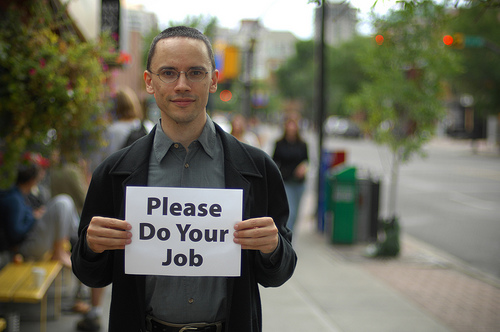
I don’t want to leave this job in a coffin

This post was inspired by a great post over at Money Smart Life called Life’s Too Short for a Crappy Job; I left a comment there, but I felt like I should repost and expand what I talked about there. I’ve been a victim of the keep-your-job-at-any-cost mentality. This is what happened to me.

I vividly remember about 12 years ago working at a consulting firm I hated. The hours were ridiculous. During the busiest part of the year 80-90 per week was standard. I broke the magic 100 one time; I’ll save you the math and point out that’s 14 hours a day, 7 days a week. In at 8 or 9 am, out at 11 pm or so.. The pay was pathetic (on an hourly basis less than minimum wage, since I didn’t get overtime). I worked so much that my girlfriend at the time dumped me after one too many cancelled dates. And worst of all, my hatred for the job and exhaustion started to cause me to make mistakes, which made me work even longer hours to fix them. But worse problems loomed.

In the story at Money Smart Life, a few of the people sticking out their terrible jobs develop tooth-grinding conditions that require dental care and maybe even surgery. And here’s what killed me about that: someone develops a teeth-grinding condition and doesn’t realize their job is killing them? They complain about their job, they suffer terrible illnesses, and don’t DO something about it? Like quit, right away?

I thought “that’s ridiculous” and then I remembered that close to the end of my awful consulting job I developed an ulcer and threw up blood a few times…. and didn’t quit. I was throwing up before and after work and thought it was just because I was stressed. Think about that and wonder why I’m not crazy. Or why I am.

What finally made me quit was this: I was getting ready to go to work one morning. I had a cold and was feeling a bit woozy, but it was a big meeting. As I put on my tie, I fell down on the floor and passed out for a few minutes. When I got up, I STILL went to work (not the hospital). I waited until after the meeting to go to my doctor, who informed me that I didn’t have a cold - I had pneumonia AND bronchitis. And that I would probably be dead in six months if I didn’t address my health.

Really - he said that. Dead in six months. He wasn’t kidding. He said it in a very doctor-ish tone, so I knew he was serious.

It took that to make me quit. And I was single and didn’t have a mortgage or car payments or anything that really tied me to that job, other than the idea that this was MY JOB (in all caps). I had destiny, and the Protestant work ethic, and I would NOT QUIT (again, in all caps). There was no reason I couldn’t quit, though, except that I was career driven. I’m not in that line of work anymore, by the way. What a waste.

I look back on it and wish I could go back and punch myself in the head and tell myself “life’s too short for a crappy job.” Completely true. Well worth remembering here, close to the start of a new year. If you’re having health problems because you hate your job that much – don’t kid yourself. It’s not you… it’s the job. Quit.

Photo is Some rights reserved by longhorndave

crappy jobs, Wal-Mart and links

florida sky

This week I came across a couple of articles that I had something to say about, and a couple I simply enjoyed for reading pleasure – plus a bunch of others that might be useful to you or that just caught my attention for one reason or another.

I’ve gotta say…

Two articles are going to prompt a few comments from me. First came Life’s Too Short for a Crappy Job. I wrote a fairly lengthy comment at the end of this post, so hop over there to read it, but the gist of my comment (and the post) was this: do not kill yourself for a job. Work hard, sacrifice, fine. Endanger your health, your sanity, or your mental stability? Never. Times are tough – I’m having a terrible time with my consulting business – but don’t assume that a job that is going to hurt you in the short term, or the long term, is something you need to pursue.

The other article was “Wal-Mart Saves You Money Even if You Never Shop There.” Well, of course it does. It depresses local communities so buying power is lower. It uses near-serf labor from developing countries for many of its goods. It doesn’t respect unions, or help with health care costs like most major corporations. It’s a bargain. I’ve come all the way from being a Wal-Mart shareholder – I made a lot of money off their stock in the 80s and 90s – to refusing to shop there. Companies like these simply can’t be the future of American capitalism. Don’t shop there for the holidays. At least shop at their marginally more responsible big-box competitors like Costco and Target (and of those two, Costco is far better).

And then a few more comments…

Using a Health Savings Account to Lower Your Medical and Health Insurance Costs: Health care costs are on the rise. Learn how a Health Savings Account can help you save money.

Should I Use a Debit Card or Credit Card? Frugal Dad examines the pros and cons of both credit cards and debit cards.

I’m switching to e-bills and e-statements: No more paper for this guy!

Best Small Business Credit Cards - Have a small business? Consider one of these cards to help provide the cash flow flexibility to meet the needs of your growing small business. Provide purchase protection and earn rewards too.

6 Things To Consider When Moving For A Job. Moving for a job can be a bad thing, or a great thing. Make certain you make that decision with your eyes wide open.

What Is Peer to Peer (Person to Person) Lending? - A description of what peer to peer lending is and how it works. Best Military Movies Giveaway. Share your favorite military movies and enter to Win $100 in Amazon Gift Cards!

And lastly, the grab bag:

5 Best Websites for Job Seekers


It can be difficult to discover careers in an unstable economy, but without the power of the internet, job searching can become even more difficult. Some job sites can help: these five job search websites make the process easier for the unemployed or underemployed - or even someone simply looking for a better opportunity.

1) Monster.com is the largest and most commonly used job search website that operates as a tool for potential employees to browse listings directly from employers.

  • Pros: According to the Wall Street Journal, 73 percent of employers spend a considerable amount of time browsing the database for potential employees. According to Greenfield Online, 61 percent of online job seekers choose Monster.com over competitor websites.
  • Cons: Creating a resume that stands out can be difficult because of Monster’s inflexibility that forces the job seeker to stick to its strict format. Also, some Monster listings are outdated or come from questionable sources. Some users have reported that they never received a response from the employer, not even an acknowledgment of a successful inquiry; this occurs because listings are often posted by recruiters and not actual employers.

2) Indeed.com is a job search engine that monitors listings from other websites. Indeed does not require the user to submit a resume, but opens up a window to job listings from other major websites.

  • Pros: Simple interface. Indeed does a great job at making the job search process simple and efficient. Also, users can subscribe to job searches which will notify them of any new listings.
  • Cons: Because Indeed is simply an interface to search for job listings, it doesn’t have a system implemented that allows the user to apply to the jobs without setting up an account with the website where the listing stands. This can be time-consuming and inefficient.


3) LinkedIn.com is a business-oriented networking site that connects potential employees to employers through a unique database.

  • Pros: LinkedIn’s unique networking capabilities can lead to interesting results. Reaching to one employer will lead to another, which leads to another. LinkedIn acts like Facebook for the job search market.
  • Cons: LinkedIn is typically utilized by professionals in any given field, so it is not as welcoming to those looking to break through in a new career.

4) Careerbuilder.com is a job listing database that allows the user to apply for jobs right through its website.

  • Pros: Like monster.com, Careerbuilder details job listings through a search that can be narrowed to suit the job seeker’s needs. The interface is simple, efficient and noteworthy because the site makes job recommendations for the user.
  • Cons: Not much makes career.com stand out from its major competitor Monster. Monster has a higher installed base of recruiters and job listings.

5) Dice.com is a job search hub website that is specificially taliored to jobs in the tech field. I’m not as familiar with this site as others, but tech-y friends of mine refer to it all the time.

  • Pros: If a user is seeking a job in an information technology field, for instance, this is the best website to start at because it details recent firings at firms, wage standards, advice, as well as job listings.
  • Cons: Dice’s advantages are also its downfall. There is nothing here that stands out from its major competitors other than a focus on tech jobs. Users may want to search other job listings, which they cannot do on Dice.

Although each website provides a service that can benefit job seekers, some are tailored for specific audiences while others have a broader appeal. Job seekers need to figure out what they are searching for before they create an account at any given site. The beauty of the internet is that they can sign up for more than one website. Personally, I’ve found one job through Careerbuilder, two through Monster and one through LinkedIn. The other two came from my college and from a cold call I made to a company I really wanted to work for. These days you’ll hear a lot of disparaging remarks about certain job sites - particularly Monster.com - but I’d still recommend keeping half an eye focused on them. They still exists because people can, and have, found jobs through them. Don’t discount any avenue towards finding work.


how America loves entrepreneurs


As I’ve written several times, I’m constantly amazed at the roadblocks thrown up in the path of entrepreneurs in America - supposedly the birthplace of the self-starter. If it’s not health insurance - my favorite bugaboo - it’s something else. Just recently I learned about one more stumbling block:

Friends of my relatives have this story to tell. They live in the northeast, and they have grown tired of the pressure of daily life in a crowded metropolitan area. They have one child with another on the way, and the same concerns about the cost of living - education, food, commutes, etc. - bore down on them. For months they have been preparing to move to another state where they planned to open their own business, the same business they currently run in their city - they have a good business that has been a profitable living for years. They currently own a house which they plan to keep and rent out. They also own another property which is rented out. They have a solid business with a good history of earning income and a solid net worth.

I don’t know them well. I’ve only met them a couple of times. As far as I know, though, they are careful, prudent, and not overextended. They had all the details worked out about their business plan for their new location. They found a house, applied for a mortgage (for which they had a more than adequate cash down payment, even though they were not selling their current properties). The mortgage was denied. The only reason given is that they are self-employed. Even though they’ve been successfully self-employed for years, they will be newly self-employed in their new state, so there’s no income history there. They are devastated, depressed, and feeling trapped. For now, they are resigned to staying where they are. They aren’t willing - as we were - to rent.

The system pushes back against people who don’t conform to a corporate ideal: the worker for a big company who has a “safe” job. I can’t see why someone with a track record of years of self-employment income would be deemed a mortgage risk, but they are. I imagine - although I’ll put it to the test soon enough - that I’d be more likely to get a mortgage as an employee of a big corporation than they would be as far more successful entrepreneurs. I’m sure if I work in the financial services industry it would seem like a better job with a “secure” income - even after Lehman, Citigroup, AIG and all of the other disasters of the past year. I would also be willing to bet that I’d have an easier time getting a mortgage after working for a corporation for 3 months than I would after working as an independent consultant for two years. Why?

I know there are reasons for these types of barriers. Banks are - and definitely should be - able to set their own risk comfort level. I’d hate to see too much government control over banks’ ability to loan - or not loan - for riskier groups. Then again, that was the whole purpose of Fannie Mae - for that quasi-governmental entity to absorb some of the risk of lending from private companies.

This story is an anecdote, and I don’t have all of the facts. Nonetheless, it does demonstrate that there are challenges on top of challenges for someone who wants to strike out on their own: heavier tax burdens (self-employment tax), discrimination against “non-safe” or “non-stable” self-employment income and the difficulty of obtaining health insurance for a self-employed individual. As plonkee commented on a recent post here:

I’m surprised anyone that’s single is self-employed in the States because of the healthcare / insurance issue. It’s notable that most or all of the Yank pro-bloggers are married, and the majority of them are married to people who work in the public sector (school teacher, crime lab scientist,military, etc). [link]

That includes any single-income family like mine, too, not just single people. People still do take the leap to become successful on their own, but as plonkee points out, it’s a lot easier when that self-employment income is backed up by a spouse with a “real” or “safe” job. I wonder how many families in America have a parent who would love to launch their own business, but shy away in fear of the consequences. I know that’s what risk means, and that some people take that risk. But it’s a shame that home ownership and health insurance are the things those people risk losing, because for some of us, that’s too much to lose.

photo credit: Old Sarge

linklings, too old for the factory edition


Another week goes by and another spate of bad job news.
I’m beginning to suspect that I may be in the “old enough to be difficult to hire” category - many of the manager positions I’ve looked at quickly turn me down. I doubt it can be my qualifications or me personally - since many of my applications don’t even make it to the phone interview stage - but perhaps they think “senior manager guy’s gonna want big money.” Or maybe my last five years consulting on Wall Street don’t look as nifty as they did a year ago - hah. I’m casting about for direction, and still hoping that one of the consulting contracts I’ve got very strong leads on will work out, so I can avoid reentering job world. I don’t feel that I want to do it, and of course that mindset doesn’t help, either.

When you are moving, life drifts into a bit of stasis. A lot of ideas about starting this or doing that get paused and filed away with “I’ll get that done after we move.” I’ve been meaning to start an LLC - but now I think I’ll wait until I’m closer to moving to Florida. I’m going to pursue some sort of certificate education (teaching? financial planning?) at one of the local colleges… down there. I’m going to start a small business, hopefully, doing some kid’s party entertainment - but now I’m just researching and won’t get started.

Of course this is just procrastination. I could start all of these things today if I felt pressure to do so. But with so many things to organize for the move these ideas seem destined for the shelf for the time being. I doubt it’s a characteristic of a successful person, but then again maybe I’m just being organized and prudent. Time will tell.

Some links for weekend reading:

My Tenant: “I’ve Lost My Job and I Can’t Pay You…”: Words that would give any landlord a sinking feeling.

Can One Choose Not To Participate In A Recession?: This is an interesting idea from the always-interesting (if not, in my opinion, always correct) Dave Ramsey.

Your Home Office: Ideas To Set Up Your Place of Work: Oh, to have a home office. I know, I am wishing for more space and a bigger home, and I know that’s verboten in the personal finance blogosphere. I sincerely hope that sometime in the future I’ll have a place with a room that can be devoted solely to work (and by work I mean blogging, writing and consulting). With a door. The door is key. Having a computer in a corner of the open-floor-plan living area is in no way conducive to getting work done during the day or putting yourself in a work mindset. My office, however, would not need to look like Gore’s. Yikes.

How Long Does It Take Your Broker to Answer Your Call?: I only have experience with three brokerage firms in the last 5-6 years. TD Ameritrade (where I keep my retirement and brokerage accounts) is terrific. They answer the phone almost immediately, and I have yet to have any trouble with my account (I say that while furiously knocking on wood).

Did You Miss the Stock Market Rally?: I don’t think March was a real rally, to be honest. I think we’ll see another dip, and I need to see one more strong runup before I’ll believe the market troubles are over. And I have to vent on a pet peeve: the market and the economy are NOT the same thing. The economy’s going to be in the dumper for a while. The market may come back long before the economy does - and by the economy I mean jobs, productivity, real estate and so on.

The 80/20 Rule and How it Applies to You: The Pareto Principle is a great way of looking at almost everything in life - if you don’t know what it is (but if you read this blog, I am sure you do), check it out.

Taking Control of Your Life By Finding Balance: I probably worry far more about balance than I should.

Poll: Generation X Feels Unprepared for Long-Term Care Costs. Are You Prepared?: I’m not. I’m one of those people who’s buried his head in the sand a bit on long-term care.

How to Save on Digital Services: We drop a LOT on digital services, although much less than we did. Probably the biggest waste? A landline, which we need because of (a) a security system and (b) we use DSL, so it’s cheaper when bundled. I’d love to have nothing but high speed internet and a Roku Digital Video Player.

How To Become An Expert: It’s true that 10,000 hours of practice will make you an expert, I suppose, although I’d argue that you may not need to be an expert to be successful - these are two different things. Practice does work, though. I’ve been learning to juggle and after spending one hour mastering the basics, I’ve been doing it every day when I have a few free minutes. 10,000 hours will be a long time in the future, but the 5-10 hours I’ve put into practice have already made me a decent three-ball juggler.

And so it begins …: Jacob is doing what a lot of us aspire to and “retiring” early. Extremely early, hence the name of his blog. Jacob’s blog is thoughtful and doesn’t focus solely on any one aspect of his life. Although he takes a different approach than I would in many areas, I’ve found his blog thought-provoking, which is the best reason to read any blog.

Why Achieving an MBA is No Longer My Goal: What? Don’t let too many people hear this - someone else decided that going into debt for a degree he didn’t really want or need wasn’t worth it because his real-life experience in building a company was - gasp - more interesting and more profitable. My master’s degree in accounting is nothing more than a resume padder at this point - think that corporate income tax course I took in 1994 is worth anything now? The code’s changed so many times since then it’s ridiculous. I didn’t mind getting my master’s since I got a free ride (graduate scholarship and a teaching assistant stipend), but would I go $40,000+ into debt to get one now? No way. MBA’s aren’t worth what they were 20 years ago.

I Am Just A Blogger, Damn It!: Amen.

4 FREE Videos for INO TV!: If you have any interest in trading actively - which I wouldn’t for retirement savings or the bulk of my investment accounts, but do engage in with smaller amounts - here are some free technical videos.

photo credit: TheeErin (great photo! — Steve)

heading to the feds

Citizens of Canada
photo credit: ItzaFineDay

I’ve noticed an interesting trend recently. The trend isn’t based on a statistical study or anything other than anecdotal evidence, but I’ve noticed that more and more professionals are leaving the private sector and heading to governmental and other public jobs. Why? Quite simply put, the value of pensions and health care are starting to outweigh the cost of salary cuts.

I worry almost daily about the value of my 401k and my IRAs (and Bubelah’s). When we are older, these accounts will be the sole source of support for us, other than our children’s generosity. Right now, those accounts don’t exactly look like a goldmine. I am confident that my earning ability (and Bubelah’s, when she eventually returns to work) will be sufficient to support us, but at the same time I have no desire to work until I’m 70. At a minimum, I want to be working solely for the joy of it by that point - I want my retirement savings to cover my living expenses, and my work to be solely for the sake of my own personal interest.

But given the current economic conditions, a lot of people are going to opt for the (currently) stable prospect of government employment. A pension, fully-paid health care and almost-guaranteed employment are tempting alternatives in the current maelstrom. As people continually seek stability versus risk, government jobs are going to become more attractive. I don’t think they provide the long-term growth potential than corporate (or especially entrepreneurial) positions do, but they don’t carry the risk of layoffs and the tedium of being judged on your merits, either.

My aspirations still point me to entrepreneurialism, but I understand the desire for safety in an uncertain world.
I simply find it amusing that once government and public sector jobs were looked down upon, but increasingly it appears that these jobs are becoming desirable. Times they are a-changin’….

sharpen your soft skills

The following is a post from Patrick of Cash Money Life. Like me, Patrick blogs on personal finance but includes a lot of posts on career management - recently he’s been chronicling his search for a new job leading right up to his resignation. His blog is in my short list of favorites; if you’ve been reading brip blap for a while you know I recommend it as a read, but if you’re new here you should check it out (or subscribe if you’re an RSS kind of person).

I recently went through the interview process with several companies. While I was interviewing with these companies, I realized something very important. While every employer seeks a different mix of abilities and experience from its employees, there is one common thing they all look for: Soft skills. Soft skills are the intangibles that you use every day to accomplish tasks. Communication skills, leadership skills, and teamwork are some common skills that employers screen for when interviewing job applicants. To put it simply, improving your soft skills increases your chances of being hired and keeping your job.

Creative Commons License photo credit: gwaar

Here are some soft skills, and ways to improve them.

Speaking. Verbal communication is highly valued by all professional organizations. Unfortunately, many people lack strong speaking skills. The good news is that you can easily improve with just a little practice. A great way to improve your speaking skills is to volunteer to give group presentations. Start small (within your team), then graduate to larger presentations. Another great way to enhance your speaking and presenting skills is to join Toastmasters International, which is a non-profit educational organization that teaches public speaking and leadership skills. They are located worldwide, so you should have an easy time locating a local chapter.

Listening. Often, the most important part of effective communication is listening. It is important to not only hear the message you are given, but to actively listen and understand the entire message. Many mistakes are made because people do not take the time to fully comprehend the message or instructions they were given. To improve your listening skills, pay attention to the speaker’s words and actions. You can learn a lot from body language. Allow the speaker to finish before responding or judging what they have said. Take notes and review them with the speaker to ensure you received the message as it was intended. Providing feedback allows you to mentally process everything you heard.

Writing. Strong written communication skills are paramount to success. It is important to be able to concisely convey your message in multiple formats including reports, letters, e-mail, online work and more. To improve your writing skills, take the time to proofread what you have written. Often many small mistakes can be corrected with a quick review. Utilize the built in spell check and grammar functions found in many productivity software applications. Other tips to improve your written communication skills include having another person proof read documents, submitting white papers to professional publications, and reviewing grammar rules online. A good place for this is Daily Writing Tips.

Leadership. Good leaders are hard to find. Leaders needs to be aware of more than just their role within a team, but how each member in the group contributes to a common goal and how to steer the group toward that goal. Some people say leaders are born and and they cannot be taught. I disagree. In fact, I think anyone can learn basic leadership skills, and some people may even grow to become great leaders. All it takes is exposure to leadership principles, the desire to lead, opportunity, and practice. To improve your leadership skills, begin with reading a few books or online articles about leadership. You can also consider taking a course at a local community college or as part of an MBA program. Once you have some leadership principles ingrained, you need to practice, practice, practice. Observe leaders in your workplace, volunteer to lead small groups and team efforts, and take on additional duties if necessary. Finally, do not confuse leadership with authority. You do not have to be the high man on the totem pole to be a leader.

Teamwork. Just as good leaders are essential to accomplish tasks in the corporate environment, so are solid team members. Even if your daily role is primarily one where your work alone, you need to be aware of how your work affects others. To improve your value as a team member, consider how your actions affect other people who are working on a related task. Do your actions help them or hinder them? Another great way to become a better team member in the workplace is to participate in group sporting events and other social activities.

There are many more soft skills

The soft skills listed above are some of the soft skills most frequently asked about during interviews. However, there are many more soft skills out there and it benefits you to recognize what they are and how to improve them. You can further break down soft skills into Personal Qualities and Interpersonal Skills: Personal Qualities are those which are inherent to the way you act on a day to day basis. These include personal responsibility, self-esteem, self-management, integrity, honesty, self-motivation, self-discipline, decision making, and more. Interpersonal Skills deal with your interactions with others. Some of these include: teaching and instructing, serving client and customer needs, negotiation, persuasion, cultural awareness, conflict resolution, etiquette, and more. Think about how you perform in the workplace. Your value to your employer is often driven not only by the degrees and certifications you hold, but how well you work and interact with others. Sharpen your soft skills. Improve your professional prospects.